French Noun Gender Rules: Patterns and Exceptions Every Learner Should Know
Ask any French learner what trips them up first, and “le or la?” comes up almost every time. Unlike English, every single French noun carries a gender — masculine or feminine — and that gender changes the article, the adjective endings, and sometimes even the pronoun you use later in a sentence. Get the gender wrong and a sentence that should sound natural suddenly feels shaky.
The good news: French noun gender isn’t nearly as random as it looks. Roughly 80% of nouns follow predictable patterns based on their endings, and once you learn those patterns — along with the exceptions that love to break them — guessing correctly becomes second nature. This guide walks through the rules, the traps, and practical ways to memorize what’s left over.
Why French Noun Gender Matters
In French, grammatical gender isn’t just a label — it’s structural. The gender of a noun determines:
- Which article you use (le, la, un, une)
- How adjectives are spelled (grand vs. grande)
- Which pronoun replaces the noun later (il vs. elle)
- Agreement in the past tense with certain verbs (il est allé vs. elle est allée)
This is why gender mistakes tend to snowball through a sentence, and why examiners on speaking and writing sections of exams like the TEF Canada or TCF Canada pay close attention to it. If you’re actively prepping for one of these exams, it’s worth pairing this guide with our Grammar Hub worksheets for targeted practice.
Masculine Noun Endings: The Reliable Patterns
Certain noun endings are masculine with striking consistency. Here are the ones worth memorizing first.
Endings That Are Almost Always Masculine
- -age: le voyage, le fromage, le message (exception: la plage, la cage, la nage)
- -ment: le gouvernement, le moment, le logement
- -eau: le bureau, le chapeau, le cadeau (exception: l’eau, la peau)
- -isme: le tourisme, le racisme, le journalisme
- -oir: le miroir, le soir, le devoir
- -al: le journal, le cheval, l’animal
- -phone: le téléphone, le microphone
Days, Months, Languages, and Numbers
Every day of the week, every month, every language, and every number in French is masculine by default: le lundi, le janvier (used with an article in specific contexts), le français, le cent. This category alone removes a lot of guesswork.
Feminine Noun Endings: The Reliable Patterns
Endings That Are Almost Always Feminine
- -tion / -sion: la nation, la télévision, la décision
- -té: la liberté, la beauté, la société
- -ette: la baguette, la bicyclette
- -ure: la voiture, la culture, la nature
- -ence / -ance: la patience, la France, la naissance
- -ie: la vie, la biologie, la boulangerie
- -elle / -esse: la vaisselle, la tristesse
These endings are so consistent that native speakers rarely even think about them — they simply “sound” feminine, the same way an English speaker instinctively knows “an apple” sounds right and “a apple” doesn’t.
The Exceptions That Break the Rules
No pattern in French survives without a few stubborn exceptions, and gender rules are no different. Here are the ones learners get wrong most often.
Nouns That Look Feminine but Are Masculine
A small group of nouns ending in -me or -ège break the feminine pattern entirely: le problème, le programme, le système, le silence, le collège. These are often borrowed from Greek, which explains why they don’t follow the usual French logic.
Nouns That Change Meaning With Gender
A handful of French words are spelled identically but mean completely different things depending on the article:
- le livre (the book) vs. la livre (the pound, currency or weight)
- le tour (the tour/turn) vs. la tour (the tower)
- le poste (the job/position) vs. la poste (the post office)
- le mode (the method/mode) vs. la mode (fashion)
These pairs are a favorite trap in listening comprehension sections, including the themed vocabulary tested at the DELF B2 level.
Feminine Words That Sound Masculine
Words like une personne (a person) and une victime (a victim) are always feminine grammatically — even when describing a man. This surprises a lot of learners the first time they hear “Paul est une personne gentille.”
Practical Strategies to Memorize Noun Gender
1. Always Learn the Article With the Noun
Never memorize a noun in isolation. Instead of learning “table,” learn “la table.” This single habit, repeated across hundreds of words, builds an instinct that no rulebook can replace.
2. Color-Code Your Vocabulary
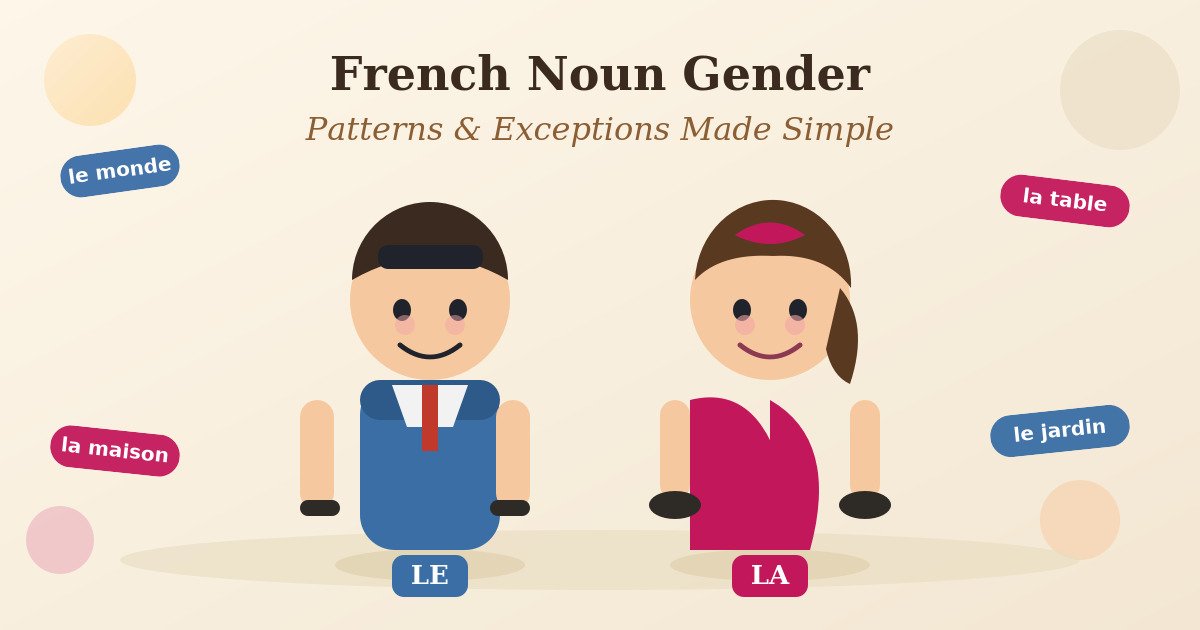
Many learners use blue for masculine and red or pink for feminine in flashcards or notebooks. The visual association reinforces memory far faster than plain text.
3. Group Words by Ending, Not by Topic
Rather than memorizing “kitchen vocabulary” or “travel vocabulary” as mixed lists, sort new words by their ending pattern. It reinforces the -tion, -age, -eau family patterns automatically.
4. Read Out Loud With the Article Attached
Reading French text aloud — even simple articles or children’s stories — while emphasizing the article before each noun trains your ear to notice when something “sounds wrong,” the same instinct native speakers rely on.
Quick Reference Table
| Usually Masculine | Usually Feminine |
|---|---|
| -age, -ment, -eau, -isme, -al, -oir | -tion, -sion, -té, -ette, -ure, -ie |
| Days, months, languages, numbers | Most abstract nouns ending in -ence/-ance |
| Trees, metals, and most colors used as nouns | Sciences and academic subjects (la chimie, la physique) |
Where Noun Gender Fits Into Your Bigger French Journey
Mastering gender patterns is one of those unglamorous grammar skills that quietly makes every other part of French easier — your adjectives agree correctly, your pronouns come out right, and your spoken French sounds noticeably more fluent. If you’re building these fundamentals from the ground up, our A1-A2 French course weaves gender rules directly into vocabulary lessons instead of teaching them as a separate topic. And if you want a structured way to test what you already know, try our free placement test.
For additional practice outside the classroom, two well-regarded free reference tools are worth bookmarking: the Larousse dictionary, which always lists gender next to every noun entry, and Lawless French’s gender guide, which offers extra drills for the exceptions covered above.
Final Thoughts
French noun gender feels overwhelming only until the patterns click — and once they do, most of your guesses will be right without even thinking about the rule. Focus on learning endings in groups, always pair nouns with their article, and give extra attention to the handful of high-frequency exceptions. Consistency beats memorization drills every time.
Want structured, guided practice instead of piecing it together on your own? Explore our full range of live French courses or head back to the blog homepage for more grammar deep-dives.