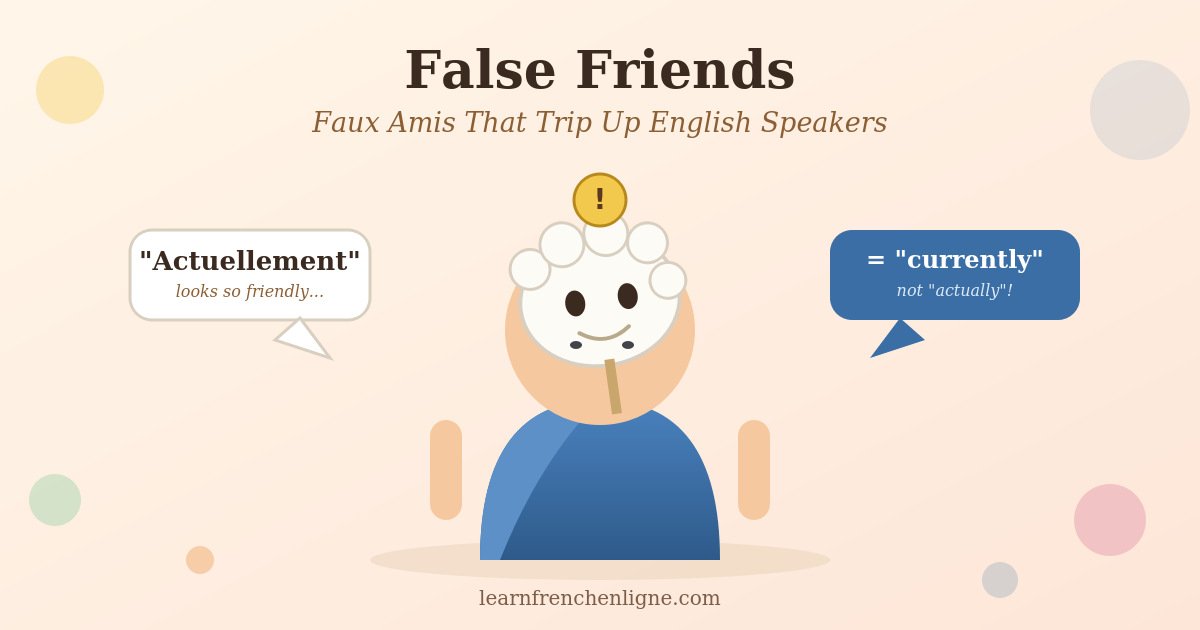
False Friends (Faux Amis) That Trip Up English Speakers
You spot a French word that looks exactly like an English one, so you use it with total confidence — and a native speaker gives you a confused look. Welcome to the world of faux amis, or “false friends”: words in French and English that share a spelling or sound but mean something completely different. They’re one of the sneakiest traps in language learning precisely because they don’t feel like mistakes. They feel like shortcuts.
This guide rounds up the false friends that catch English speakers most often, organized by how badly they can backfire, plus a few tricks for spotting new ones on your own.
Why False Friends Are So Dangerous
Most vocabulary mistakes get corrected quickly because they sound obviously wrong. False friends are different — they sound completely natural, which means you can repeat the same mistake for months without anyone flagging it. Worse, on exams like the TEF Canada or TCF Canada, a false friend used in writing or speaking can change the meaning of your answer entirely, which examiners do notice.
The good news is that most high-frequency false friends fall into a small number of predictable categories, so once you’ve seen the pattern, you stop falling for new ones.
The Most Common False Friends English Speakers Fall For
Words That Sound Innocent but Mean Something Else Entirely
- Actuellement — does not mean “actually,” it means “currently / at the moment”
- Librairie — does not mean “library,” it means “bookshop” (a library is une bibliothèque)
- Coin — does not mean a metal coin, it means “corner”
- Blesser — does not mean “to bless,” it means “to injure or wound”
- Attendre — does not mean “to attend,” it means “to wait”
- Rester — does not mean “to rest,” it means “to stay/remain”
False Friends That Can Be Genuinely Embarrassing
- Préservatif — does not mean “preservative” (in food), it means “condom.” The word you want for food preservative is conservateur.
- Baiser — as a noun means “a kiss,” but as a verb it’s vulgar slang; use embrasser for “to kiss” instead
- Douche — simply means “shower,” with none of the negative connotation the English slang term has
Words That Reverse Meaning Entirely
- Sensible — does not mean “sensible/practical,” it means “sensitive”
- Ignorer — does not mean “to ignore on purpose,” it means “to not know / be unaware of”
- Introduire — usually means “to insert,” not “to introduce a person” (use présenter for that)
- Assister à — does not mean “to assist,” it means “to attend” (a meeting, a class, an event)
False Friends in Business and Formal French
- Achever — does not mean “to achieve,” it means “to finish/complete”
- Demander — does not mean “to demand” forcefully, it simply means “to ask”
- Éventuellement — does not mean “eventually,” it means “possibly / if need be”
- Formidable — does not mean “formidable/intimidating,” it means “great/wonderful”
These last few are especially common in professional French, which is exactly the context covered in our TEF Canada preparation course — misusing demander or assister à in a formal email or oral exam response is one of the more common small errors that adds up on a scoring rubric.
Faux Amis vs. “Semi-False” Friends: Know the Difference
True False Friends
These share no meaning overlap at all — librairie and “library” are unrelated concepts entirely, despite looking identical.
Semi-False Friends (Partial Overlap)
Some words share one meaning but not others, which makes them trickier. Journée means “day” (like English “journey” once did, historically), but you can’t use it to mean “a trip.” Large in French means “wide,” not “big/large” in general — for that you’d use grand. These partial overlaps are worth extra attention because your brain assumes full overlap once it finds one match.
How to Avoid Falling Into the Faux Amis Trap
1. Learn False Friends in Contrastive Pairs
Instead of memorizing actuellement alone, learn it directly alongside its real English lookalike and its actual French equivalent: actuellement = currently; “actually” = en fait. Pairing the mistake with the correction cements both in memory at once.
2. Keep a Personal “Faux Amis” List
Every time you catch yourself using a false friend incorrectly (or a teacher corrects you), add it to a running list. Reviewing your own mistakes is far more effective than studying someone else’s generic list, because it targets exactly the words your brain keeps defaulting to.
3. Double-Check High-Stakes Vocabulary Before Exams or Emails
Before writing a professional email or walking into a speaking exam, skim through a false-friends list relevant to that context. A few minutes of review can prevent a mistake that would otherwise slip out unnoticed, especially in DELF/DALF writing tasks or during the themed vocabulary tested at the DELF B2 level.
4. Read Widely in French
Seeing these words used correctly and repeatedly in real context — news articles, books, subtitles — trains your instinct faster than memorized lists alone. Over time, the correct meaning simply starts to feel right.
Quick Reference: 20 False Friends at a Glance
| French Word | Looks Like | Actually Means |
|---|---|---|
| Actuellement | Actually | Currently |
| Librairie | Library | Bookshop |
| Coin | Coin (money) | Corner |
| Blesser | To bless | To injure |
| Attendre | To attend | To wait |
| Rester | To rest | To stay |
| Sensible | Sensible | Sensitive |
| Ignorer | To ignore | To not know |
| Assister à | To assist | To attend |
| Achever | To achieve | To finish |
| Demander | To demand | To ask |
| Éventuellement | Eventually | Possibly |
| Formidable | Formidable | Great/wonderful |
| Préservatif | Preservative | Condom |
| Douche | Douche (slang) | Shower |
| Journée | Journey | Day |
| Large | Large | Wide |
| Introduire | To introduce (a person) | To insert |
| Passer un examen | To pass an exam | To take an exam |
| Monnaie | Money (in general) | Change/coins |
Where This Fits Into Your Broader French Learning
False friends sit right alongside the other small details that separate intermediate French from fluent French — the same way getting noun gender right smooths out your grammar, catching faux amis smooths out your vocabulary. If you’re building your French from the ground up, our A1-A2 French course introduces common vocabulary traps early, before they turn into habits. And if you want to see exactly where your vocabulary stands right now, take our free placement test.
For deeper reference outside the classroom, two solid free resources are worth bookmarking: Lawless French’s faux amis glossary, which categorizes dozens of tricky pairs, and the WordReference French-English dictionary, which is useful for quickly double-checking a word before you use it in something important.
Final Thoughts
False friends catch even advanced learners off guard precisely because they look so trustworthy. The fix isn’t memorizing every possible faux ami in existence — it’s building the habit of double-checking words that seem “too easy,” especially ones that look identical to English. Learn them in pairs, keep a running list of your own slip-ups, and read real French regularly so the correct meanings start to feel natural.
Want more grammar and vocabulary deep-dives like this one? Explore our full range of live French courses or head back to the blog homepage for more.