
Which words to learn, when to review them and which tool to use. A clear system for beginners, with a 4-week plan you can start today.
Timed reviews flatten the forgetting curve, so each word fades more slowly.
Do you keep forgetting French words a few days after you learn them? The honest answer is that it is rarely a problem of talent. It is a problem of timing. The most reliable way to learn French vocabulary with spaced repetition is to review each word at growing gaps, just before you would forget it. This guide shows you what to put on your cards, how to schedule your reviews, which free tools to use and how to turn it into a daily habit.
⚡ Key Takeaways
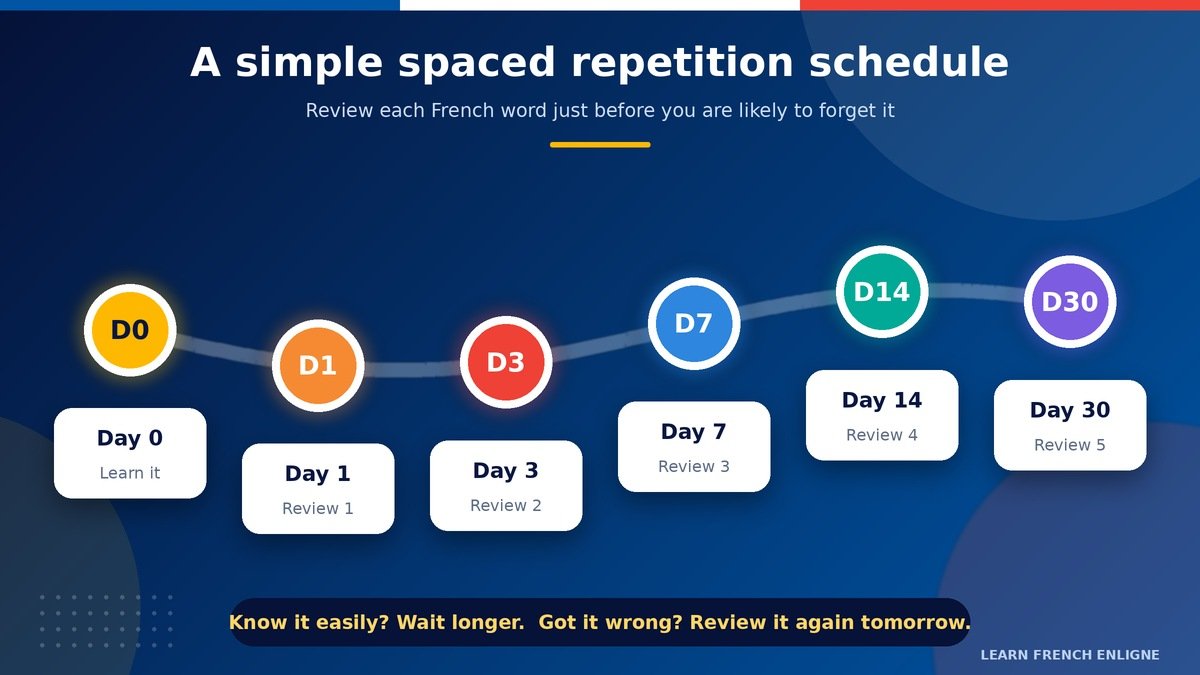
- Review each word at growing gaps: Day 1, 3, 7, 14 and 30 is a proven starting rhythm.
- Put the article and one short sentence on every card, so gender and context travel with the word.
- Say the answer aloud before you flip the card. Active recall beats re-reading.
- Keep new words to about 10 a day. Consistency beats volume.
- Use Anki, Quizlet or a paper Leitner box. The best tool is the one you open daily.
📑 In this guide
What Is Spaced Repetition and Why Does It Work for French Vocabulary?
Spaced repetition is a study method where you review information at increasing gaps: a day, three days, a week, two weeks, then a month. Easy items come back less often. Hard items come back more often. Each review arrives just as the memory starts to fade, and every successful recall makes it last longer.
The forgetting curve in plain English
In the 1880s, psychologist Hermann Ebbinghaus studied how fast we forget new information. His work gave us the forgetting curve: without review, we lose a large share of new material within days. Each well-timed review flattens the curve, as the graphic above shows.
4 Golden Rules for Better French Flashcards
A good card is small but complete. Follow these four rules and your reviews will be faster and more effective.
Add the article
le / la / l’Learn la maison, not just maison. Gender sticks when it travels with the noun.
Add one sentence
1 card = 1 ideaA short example shows how the word behaves and gives your brain context to hold on to.
Say it aloud
Active recallSpeak the French before you flip the card. Struggling for a second or two is the point.
Keep it small
About 10 a dayEvery new word adds future reviews, so keep your daily pile manageable.
What a good card looks like: article, sound guide and one short sentence.
How to Learn French Vocabulary with Spaced Repetition: 5 Steps
Choose Words You Will Actually Use
Start with high-frequency words and themes from your daily life: food, family, work, transport, greetings. If you follow the CEFR levels (A1 to C2), build your list around your current level plus a few words from the next one. Not sure of your level? Take our free placement test.
Build Clear, Complete Flashcards
Put the English meaning on the front. On the back, add the French word with its article, a short example sentence and, if your tool allows it, audio. Do not squeeze three meanings onto one card.
Use Active Recall
Look at the English side and say the French out loud before you flip. Reading the answer passively trains recognition. Producing it trains memory. Once you are comfortable, practise both directions.
Follow a Review Schedule
Let an app handle the timing, or follow the pattern in the next section by hand. If you forget a word, send it back to the start of the schedule.
Keep New Words Sustainable
Increase your daily number only when your review pile feels easy. Ten words a day for a month beats a hundred words in one weekend, every time.
Your Review Schedule
A common starting rhythm looks like this. The gap grows each time you remember the word.
| Review | When | What to do |
|---|---|---|
| Learn it | Day 0 | Read the card, say the word and the sentence aloud |
| Review 1 | Day 1 | Try to recall it before you flip the card |
| Review 2 | Day 3 | Recall it, then say the example sentence |
| Review 3 | Day 7 | Recall it; if it was hard, move it back a step |
| Review 4 | Day 14 | Recall it; make a new sentence of your own |
| Review 5 | Day 30 | Quick check; the word is now in long-term memory |
Which Spaced Repetition Tool Should You Pick?
The golden rule is simple: pick the tool you will open every single day. Check each tool’s official site for current platforms and pricing.
Sample French Vocabulary Flashcards
Here is how a few beginner cards could look. In the table, the red italic text is an English-friendly sound guide, with capitals marking the stressed part.
| English | French | Say it like | Example sentence |
|---|---|---|---|
| the apple | la pomme | la POM | Je mange une pomme. |
| the book | le livre | luh LEE-vruh | Le livre est sur la table. |
| to eat | manger | mon-ZHAY | Nous mangeons à midi. |
| thank you | merci | mehr-SEE | Merci beaucoup pour votre aide. |
| the school | l’école (f.) | lay-KOL | Les enfants vont à l’école. |
| to have | avoir | a-VWAR | J’ai deux frères. |
To hear real voices, use the free audio on Forvo, where native speakers record individual words.
How Long Does It Take? Your 4-Week Plan
It depends on your starting point and how consistently you review, so treat this as a planning guide rather than a promise.
Week 1
10 words a day · 15 minGreetings, numbers, family and food. Build the daily habit first.
Week 2
10 words a day · 15 to 20 minDaily routine, home and common verbs. Keep reviews on schedule.
Week 3
10 to 15 words a day · 20 minWork, travel, shopping and time expressions. Add words only if reviews feel easy.
Week 4
10 to 15 words a day · 20 minReview weak cards, add your own sentences and speak every word aloud.
Want to see how this fits into a longer journey? Read our DELF A1 to B2 roadmap and our guide on how long it takes to learn French fluently.
What to practise alongside your cards
- Grammar: turn words into sentences with our free French grammar worksheets.
- Connectors: sound more natural with our 100 French connectors guide.
- Real use: practise with French words for travel and French slang.
- Listening: ten minutes a day of RFI Français Facile trains your ear for natural speed.
- Next level: ready to move up? See our B1 to B2 level-up guide.
Using Spaced Repetition for TEF, TCF and DELF
Vocabulary is one of the fastest ways to raise your score across reading, listening, writing and speaking. Build separate decks for exam themes such as work, housing, health, education and public services. Learners in our TEF Canada preparation program and DELF B1 preparation program combine this method with live speaking practice. On a tight deadline? Read how to reach CLB 5 in French in 4 months, and use our DELF exam preparation guide so nothing surprises you on test day.
✅ Before Your First Session, Check These
- ✅ I have chosen my first 10 words and added the article to each.
- ✅ Every card has one short example sentence.
- ✅ I say the answer aloud before I flip the card.
- ✅ I have picked a tool: Anki, Quizlet or a paper Leitner box.
- ✅ I know my review dates for Day 1, 3, 7, 14 and 30.
- ✅ I have a fixed daily time for reviews.
Common Mistakes Learners Make
Start small, review daily, and let the schedule do the heavy lifting. That order saves time and frustration.
Ready to Make Your French Words Stick?
Train with live classes, corrected speaking practice and regular mock tests.
A1-A2 CourseDELF B1DELF B2Free Consultation
Not sure where to start? Take our free placement test.
Frequently Asked Questions About Learning French Vocabulary with Spaced Repetition
How many French words should I learn per day with spaced repetition?
Most beginners do well with 10 to 15 new words a day. Every new word adds future reviews, so a number you can keep up beats a big number you abandon in week two.
How long does spaced repetition take to work?
You will notice words coming back faster within two weeks. Lasting vocabulary builds over months, because the long gaps (two weeks, a month) are what move words into long-term memory.
Is Anki or Quizlet better for French vocabulary?
Anki gives you more control and stronger scheduling, which suits serious learners. Quizlet is easier to start with. Either works if you review daily. Check each app’s current features and pricing before you commit.
Can I use spaced repetition without an app?
Yes. A paper Leitner box with five compartments follows the same principle. You only need index cards, a box and a few minutes each day.
Should I learn single words or phrases?
Phrases and short sentences are better. “L’addition, s’il vous plaît” is more useful than “addition” alone, and context makes the word easier to remember.
Does spaced repetition help for TEF, TCF or DELF exams?
Yes. Exams reward a wide, accurate vocabulary, and spaced repetition is one of the most efficient ways to build and keep it. Pair it with speaking and writing practice so you can use the words, not just recognise them.
What if I miss a day of reviews?
Do a shorter session the next day and clear the oldest cards first. Do not try to catch up on everything at once, and do not quit.
Disclaimer: this article is general learning guidance. Results vary from person to person, and study timelines are estimates, not guarantees. Tool features, platforms and pricing change, so check each official site before you commit. Pronunciation guides are simplified for English speakers.