French · A1 Travel Vocabulary · Updated September 2026
French Words for Travel: 100+ Essential Words & Phrases for Your First Trip to France
Picture this: you land in Paris, walk into a bakery and say a confident “Hello!” in English. The person behind the counter answers politely but a little coolly. Now imagine you had said “Bonjour, madame” first. Same bakery, completely different mood.
That small difference is what this guide is about. You do not need to be fluent to enjoy France, Belgium, Switzerland, Québec or any French-speaking destination. You need about a hundred useful words, the right manners and a bit of pronunciation confidence. Below you will find them sorted by situation, so you can find what you need in seconds, even on a moving train.
Quick answer: The five words that matter most are bonjour (hello), s’il vous plaît (please), merci (thank you), excusez-moi (excuse me) and parlez-vous anglais ? (do you speak English?). Always greet first, then ask.
4 Golden Rules of French Manners
Pronunciation in 60 Seconds
You do not need a perfect accent, but five habits make you far easier to understand. In the tables below, the red italic text shows an English-friendly sound guide. Capital letters mark the stressed part, which in French usually falls on the last syllable.
- Final consonants are often silent. Paris sounds like “pa-REE”, and petit like “puh-TEE”.
- Nasal vowels (bon, vin, sans) are said through the nose, without a hard “n” at the end.
- The French “r” comes from the back of the throat, close to a soft gargle. A light attempt is fine.
- Letters link. In “vous avez”, the s sounds like a z: “voo-za-VAY”. This is called liaison.
- Accents matter. é sounds like “ay”, è like “eh”, and ç like “s”.
To hear real voices, use the free audio on Forvo, where native speakers record individual words.
Greetings and Politeness
| English | French | Say it like |
|---|---|---|
| Hello / good day | Bonjour | bon-ZHOOR |
| Good evening | Bonsoir | bon-SWAR |
| Hi / bye (informal) | Salut | sa-LOO |
| Goodbye | Au revoir | oh ruh-VWAR |
| Have a nice day | Bonne journée | bon zhoor-NAY |
| Please | S’il vous plaît | seel voo PLEH |
| Thank you (very much) | Merci (beaucoup) | mehr-SEE (boh-KOO) |
| You’re welcome | De rien | duh ree-AN |
| Excuse me / sorry | Excusez-moi / Pardon | ex-koo-zay MWAH / par-DON |
| Yes / No | Oui / Non | wee / noh(n) |
| Do you speak English? | Parlez-vous anglais ? | par-lay voo on-GLAY |
| I don’t understand | Je ne comprends pas | zhuh nuh kom-PRON pah |
| Please repeat | Pouvez-vous répéter, s’il vous plaît ? | poo-vay voo ray-pay-TAY |
| A little slower, please | Plus lentement, s’il vous plaît | ploo lont-MON |
| My name is… | Je m’appelle… | zhuh ma-PELL |
Getting Around
| English | French | Say it like |
|---|---|---|
| Where is the station? | Où est la gare ? | oo eh la GAR |
| Airport / metro / bus stop | L’aéroport / le métro / l’arrêt de bus | la-ay-ro-POR / may-TRO / la-REH duh boos |
| A ticket, please | Un billet, s’il vous plaît | uh bee-YAY |
| One-way / return | Un aller simple / un aller-retour | uh na-LAY SAM-pluh / ral-lay ruh-TOOR |
| Which platform? | Quel quai ? | kel KAY |
| Left / right / straight on | À gauche / à droite / tout droit | a GOHSH / a DRWAT / too DRWA |
| Is it far? | C’est loin ? | seh LWAN |
| Where are the toilets? | Où sont les toilettes ? | oo son lay twa-LET |
| I’m looking for… | Je cherche… | zhuh SHERSH |
| Exit / entrance | La sortie / l’entrée | la sor-TEE / lon-TRAY |
Hotel and Accommodation
| English | French | Say it like |
|---|---|---|
| I have a reservation | J’ai une réservation | zhay oon ray-zer-va-SYON |
| A room for two | Une chambre pour deux | oon SHOM-bruh poor DUH |
| Is breakfast included? | Le petit-déjeuner est-il compris ? | luh puh-tee day-zhuh-NAY eh-teel kom-PREE |
| Is there Wi-Fi? | Y a-t-il du wifi ? | ee ya-TEEL doo wee-FEE |
| The key / the passport | La clé / le passeport | la KLAY / luh pass-POR |
| Can I leave my luggage? | Puis-je laisser mes bagages ? | pwee-zhuh lay-SAY may ba-GAZH |
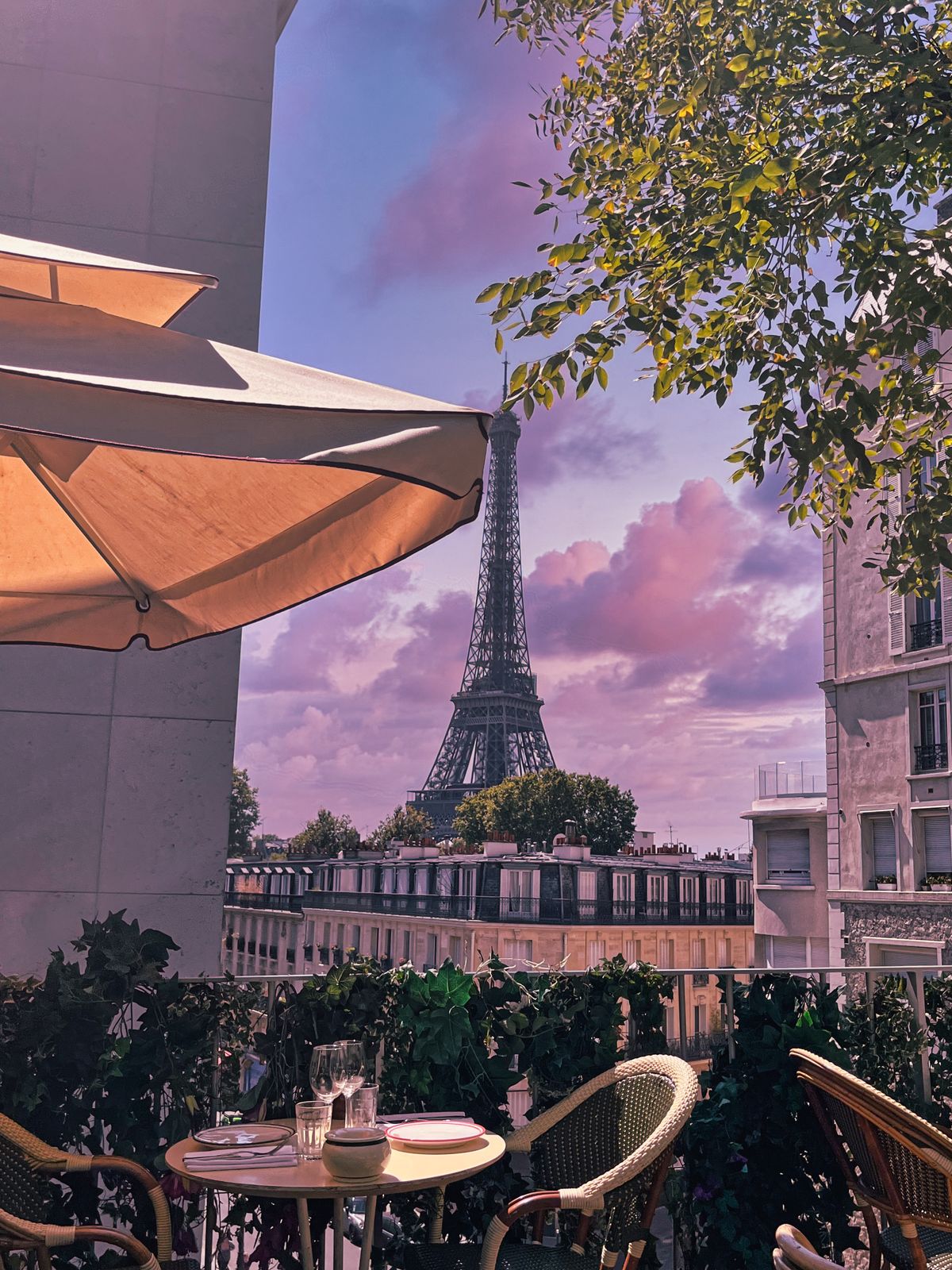
Restaurants and Cafés
| English | French | Say it like |
|---|---|---|
| A table for two, please | Une table pour deux, s’il vous plaît | oon TAH-bluh poor DUH |
| The menu, please | La carte, s’il vous plaît | la KART |
| I would like… | Je voudrais… | zhuh voo-DRAY |
| A jug of tap water | Une carafe d’eau | oon ka-RAF DOH |
| Coffee / tea / wine | Un café / un thé / du vin | uh ka-FAY / uh TAY / doo VAN |
| I’m vegetarian | Je suis végétarien(ne) | zhuh swee vay-zhay-ta-RYAN |
| I’m allergic to… | Je suis allergique à… | zhuh swee za-ler-ZHEEK a |
| Enjoy your meal! | Bon appétit ! | bon a-pay-TEE |
| It was delicious | C’était délicieux | say-TAY day-lee-SYUH |
| The bill, please | L’addition, s’il vous plaît | la-dee-SYON |
Good to know: In French restaurants the bill does not arrive until you ask for it, and service is normally already included in the price (“service compris”), so extra tipping is optional. Asking for “une carafe d’eau” gets you free tap water.
Shopping and Money
| English | French | Say it like |
|---|---|---|
| How much is it? | C’est combien ? / Combien ça coûte ? | seh kom-BYAN / sa KOOT |
| Just looking, thanks | Je regarde, merci | zhuh ruh-GARD |
| Can I pay by card? | Puis-je payer par carte ? | pwee-zhuh pay-YAY par KART |
| Cash | En espèces | on es-PESS |
| A bigger / smaller size? | Une taille plus grande / plus petite ? | oon TIE ploo GRAND / ploo puh-TEET |
| Do you have a bag? | Avez-vous un sac ? | a-vay voo zuh SAK |
| Sales | Les soldes | lay SOLD |
Emergencies and Health
Save these numbers: 112 works across Europe, including France. Within France you can also call 15 (medical, SAMU), 17 (police) and 18 (fire brigade).
| English | French | Say it like |
|---|---|---|
| Help! | Au secours ! | oh suh-KOOR |
| Call the police! | Appelez la police ! | a-play la po-LEES |
| I need a doctor | J’ai besoin d’un médecin | zhay buh-ZWAN duh may-d-SAN |
| Where is the pharmacy? | Où est la pharmacie ? | oo eh la far-ma-SEE |
| I feel unwell | Je me sens mal | zhuh muh son MAL |
| I lost my passport | J’ai perdu mon passeport | zhay per-DOO mon pass-POR |
| My bag was stolen | On m’a volé mon sac | on ma vo-LAY mon SAK |
Numbers and Time
Ask the time with “Quelle heure est-il ?” (kel UR eh-TEEL). To learn numbers in a fun, structured way, the free lessons on TV5Monde Learn French are a solid companion.
Words That Trick Travellers
Some French words look English but mean something different. These are the ones most likely to cause a confused smile on your trip.
| French word | Looks like | Actually means |
|---|---|---|
| la monnaie | money | small change (money is “l’argent”) |
| la librairie | library | a bookshop (a library is “une bibliothèque”) |
| la location | location | a rental, such as a car or flat |
| les chips | chips (fries) | crisps (fries are “les frites”) |
| attendre | to attend | to wait |
| demander | to demand | to ask |
| actuellement | actually | currently, at the moment |
Three Mini Dialogues You Can Copy
1. Ordering at a café
Serveur : Bonjour, vous désirez ?
Hello, what would you like?
Vous : Bonjour ! Un café crème et un croissant, s’il vous plaît.
Hello! A coffee with milk and a croissant, please.
Serveur : Voilà.
Here you are.
Vous : Merci. L’addition, s’il vous plaît.
Thanks. The bill, please.
2. Buying a train ticket
Vous : Bonjour, un aller simple pour Lyon, s’il vous plaît.
Hello, a one-way ticket to Lyon, please.
Guichetier : C’est pour quelle date ?
For which date?
Vous : Demain matin.
Tomorrow morning.
3. Hotel check-in
Vous : Bonjour, j’ai une réservation au nom de Sharma.
Hello, I have a reservation under the name Sharma.
Réception : Bienvenue ! Votre passeport, s’il vous plaît.
Welcome! Your passport, please.
Vous : Voilà. Le petit-déjeuner est-il compris ?
Here you go. Is breakfast included?
Strategies: A 7-Day Pre-Trip Plan
Twenty focused minutes a day beats one long cram session. Here is a simple schedule you can start a week before you fly.
| Day | Focus | Do this |
|---|---|---|
| 1 | Greetings and manners | Say the whole greetings table aloud; practise bonjour + madame/monsieur |
| 2 | Sounds | Listen to 15 words on Forvo, then record yourself and compare |
| 3 | Getting around | Role-play asking for the station and a ticket |
| 4 | Food | Read a real French menu online; practise “Je voudrais…” |
| 5 | Shopping + numbers | Say prices aloud as you see them in daily life |
| 6 | Emergencies | Save the emergency numbers in your phone and repeat the help phrases |
| 7 | Review | Do all three dialogues out loud without looking |
Four memory strategies that really work
- Learn phrases, not single words. “L’addition, s’il vous plaît” is more useful than “addition” alone.
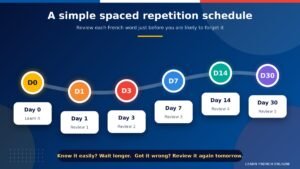
- Use spaced repetition. A free tool like Anki brings back a card right before you forget it.
- Speak out loud. Reading silently trains your eyes; speaking trains your mouth, which is what you need at the counter.
- Train your ear. Ten minutes of RFI Français Facile a day gets you used to natural speed.
Mistakes to avoid
- Skipping the greeting and starting with a request.
- Using tu with shopkeepers or waiters.
- Pronouncing final consonants, such as saying the s in Paris.
- Relying only on a translation app in a fast conversation.
Your Pre-Trip Checklist
Want to go beyond a phrasebook?
Learn French Enligne offers live online classes with certified trainers, from your first bonjour to DELF and TCF preparation. Try a class and speak French with confidence before you travel.
Explore French Classes See Speaking CoursesFrequently Asked Questions
What are the most important French words for travel?
Bonjour, s’il vous plaît, merci, excusez-moi, pardon, oui, non, au revoir and “parlez-vous anglais ?”. These polite basics change how people respond to you more than any long vocabulary list.
Do I need to speak French to travel in France?
No, and in major tourist areas English is often understood. Still, locals appreciate a greeting and a few phrases in French, and outside big cities French becomes far more useful.
How many French words do I need for a two-week trip?
Around 100 well-chosen words and phrases cover greetings, transport, food, shopping and emergencies for most first-time visitors.
What is the emergency number in France?
112 is the general European emergency number and works in France. France also uses 15 for medical emergencies, 17 for police and 18 for the fire brigade.
Is it rude to speak English in France?
Not if you start politely. Greet in French first, then ask “parlez-vous anglais ?”. That small effort usually earns a warmer reply.