French Liaison Rules Made Simple: When to Link Words and When Not To
If you’ve ever paused a French podcast, rewound a sentence three times, and still couldn’t figure out where one word ended and the next one began — you’ve met liaison. It’s one of the biggest reasons spoken French sounds nothing like the French you read in a textbook, and it’s exactly why the jump from B1 to B2 feels like hitting a wall.
The good news? Liaison isn’t random. It follows a small set of rules that, once you know them, make native-speed French dramatically easier to decode — and make your own spoken French sound far more natural. This guide breaks liaison down into three simple categories: mandatory, forbidden, and optional — with real examples, sound-change charts, and practice sentences you can use today.

What Is Liaison in French (and Why It Wrecks Your Listening Comprehension)?
Liaison happens when a normally silent final consonant is pronounced because the next word starts with a vowel sound. Take vous avez — on paper, the “s” in vous is silent. But said aloud, it becomes vouzavez. That extra “z” sound didn’t exist in either word alone; it only appears because the two words are linked.
This single feature is one of the main reasons our B1 to B2 French guide flags listening comprehension as the toughest part of the intermediate plateau. Native speakers talk at 180–200 words per minute, and liaison (along with elision and dropped syllables) means the words you know perfectly well in writing suddenly sound unrecognizable in speech. Once you learn the rules below, that fog starts to clear.
The 3 Types of French Liaison You Need to Know
Every liaison situation in French falls into one of three buckets. Learning to sort words into these categories is the entire game.
1. Liaison Obligatoire (Mandatory Liaison)
You must link the words. Skipping it sounds like a grammar mistake to a native ear.
2. Liaison Interdite (Forbidden Liaison)
You must never link the words, even though it might feel natural to. Linking here sounds foreign or overcorrected.
3. Liaison Facultative (Optional Liaison)
Native speakers use their judgment — formal speech links more, casual speech links less. As a learner, you have flexibility here.

Mandatory Liaisons: When You Must Link the Words
Subject Pronoun + Verb
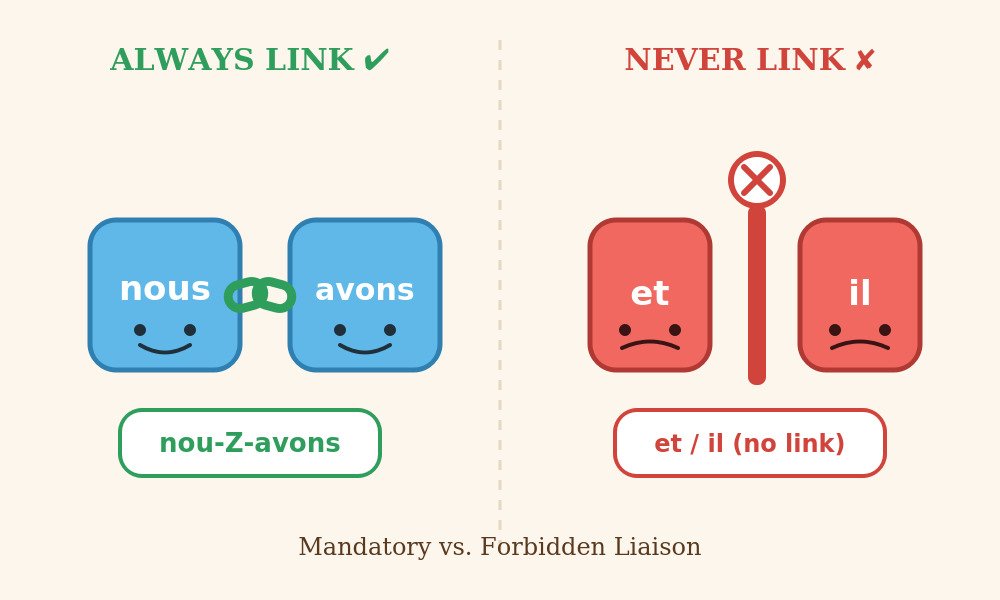
Nous avons (nouzavons), ils ont (ilzont), on a (onna), vous êtes (vouzêtes). This is the liaison you’ll hear the most, and it’s non-negotiable.
Article or Determiner + Noun
les amis (lezamis), un homme (unhomme), mon ami (monami), ces enfants (cezenfants). Any determiner sitting directly before a vowel-starting noun links.
Adjective + Noun (When the Adjective Comes First)
un petit ami (petittami), de grands hommes (grandzhommes), un bon élève (bonélève). Since French usually places adjectives after the noun, this rule mostly applies to the small set of adjectives that come before it (petit, grand, bon, mauvais, gros, etc.).
After Short Prepositions and Adverbs
dans un (danzun), chez elle (chezelle), très intéressant (trèzintéressant), bien aimé (bienaimé), plus utile (pluzutile).
Fixed Expressions
Some phrases are memorized as a single sound block: de temps en temps, de plus en plus, Comment allez-vous ?, tout à coup, de mieux en mieux. Learn these as whole chunks rather than word-by-word.
Forbidden Liaisons: When You Must Never Link the Words
After “Et” (And)
This is the single most common liaison mistake learners make. Et il is always pronounced with a clean break: et / il — never et-t-il. If you remember only one forbidden rule, make it this one.
Before a Word Starting with an Aspirated “H” (H Aspiré)
French has two kinds of silent H: the “mute h” (h muet), which allows liaison, and the “aspirated h” (h aspiré), which blocks it entirely. les héros is pronounced le / héros (no liaison), while les hommes is lezhommes (liaison happens). There’s no visual way to tell them apart — you simply have to learn which words take h aspiré (common ones: le hasard, le héros, la honte, le hibou, la haine, le homard).
Singular Noun + Following Adjective
Unlike article + noun, a singular noun generally does not link to the adjective after it: un enfant / adorable — no liaison between enfant and adorable, even though adorable starts with a vowel.
Before “Oui,” Numbers Like “Onze,” and a Few Others
les oui, les onze, and les huit (in some registers) resist liaison because these words historically behaved like they started with a consonant.
Optional Liaisons: The Grey Zone Between Formal and Casual
Optional liaisons show up mostly after plural nouns before adjectives, after forms of the verb être, and after certain adverbs and prepositions in longer clauses — for example, ils sont / arrivés vs. the more formal ils sontarrivés.
Formal Speech vs. Casual Speech
News anchors, politicians, and formal presentations lean toward linking more. Friends chatting over coffee link less. Neither is “wrong” — they simply signal register.
What Should You Do as a Learner?
At B1–B2 level, the safest strategy is: use mandatory liaisons every time, avoid forbidden liaisons every time, and don’t stress about optional ones. Native speakers will understand you either way — and as you listen more, you’ll naturally absorb which optional liaisons sound right in which context.
How Liaison Changes the Sound of Letters
Liaison doesn’t just “add” the written letter — it often converts it into a different sound entirely. Here’s the cheat sheet:
| Written Letter | Liaison Sound | Example |
|---|---|---|
| s / x | /z/ | les amis → lezamis |
| d | /t/ | un grand homme → granthomme |
| f | /v/ | neuf ans → neuvans |
| g | /k/ | long été → lonkété |
| n | /n/ (nasal drops) | un ami → unami |
Liaison vs. Enchaînement: What’s the Difference?
Learners often confuse liaison with enchaînement (linking), but they’re not the same thing. Liaison involves a consonant that is normally silent becoming pronounced. Enchaînement involves a consonant that is already pronounced simply sliding into the next word: elle arrive becomes ellarrive — the “l” was always going to be pronounced; it just moves to attach to the next syllable. Both create that smooth, connected sound of native French, but only liaison adds a “new” sound that wasn’t there in isolation.
7 Practice Sentences to Train Your Ear
- Nous avons deux enfants. → nou-za-vons
- Ils sont arrivés hier soir. → optional: il-son-ta-rri-vés or il-son / a-rri-vés
- C’est un excellent élève. → ce-tun-nex-cellent
- Vous êtes intéressé ? → vou-zêtes-in-té-res-sé
- Et il arrive. → et / il-a-rrive (no liaison after “et”)
- Les héros du film. → le / hé-ros (no liaison — h aspiré)
- Un grand ami. → un-gran-ta-mi
Try reading these aloud, then compare your pronunciation with audio from native sources like TV5Monde or the Journal en français facile from RFI, both of which speak at a clear, learnable pace.
Quick Reference Table: Liaison Rules at a Glance
| Rule Type | Do You Link? | Example |
|---|---|---|
| Pronoun + verb | Always | nous avons |
| Determiner + noun | Always | les amis |
| After “et” | Never | et il |
| Before h aspiré | Never | les héros |
| Singular noun + adjective | Never | un enfant adorable |
| Plural noun + adjective / être forms | Optional | ils sont arrivés |
How to Practice Liaison Like a Native
Rules only take you so far — liaison is ultimately a listening and repetition skill. The shadowing technique covered in our B1 to B2 upgrade guide works especially well here: listen to a short native clip, pause after each sentence, and repeat it out loud immediately, copying the rhythm and the linking exactly as you heard it — not just the individual words.
If you’re preparing for the DELF B1 speaking exam, correct liaison is part of what separates a “comprehensible” answer from a genuinely natural-sounding one. Our walkthroughs on the DELF B1 Exercice 2 interaction strategy and the DELF B1 Exercice 3 model answer both include model spoken answers you can shadow for liaison practice. And once your spoken French starts flowing more naturally, it’s worth applying the same attention to detail to your writing — our guide on French writing skills for emails and letters is a solid companion piece for rounding out your production écrite alongside your speaking.

Frequently Asked Questions About French Liaison
Is liaison the same as elision?
No. Elision is when a vowel is dropped and replaced with an apostrophe before another vowel sound, like le + ami becoming l’ami. Liaison is about pronouncing an otherwise-silent consonant. They often appear together in the same sentence but are two separate phenomena.
Will I sound wrong if I skip an optional liaison?
No — native speakers skip optional liaisons constantly in casual conversation. Skipping a mandatory one, or adding a forbidden one, is what actually sounds off to a native ear.
What’s the fastest way to internalize liaison rules?
Active listening combined with reading aloud. Pick short audio clips slightly below your comfort level, transcribe what you hear, then compare it to the written script to spot exactly where liaisons happened.
Does liaison matter for exams like the DELF or TEF?
Yes — examiners assess pronunciation and fluency, and correct liaison is one of the clearest markers of natural spoken French at B1 level and above.
Final Thoughts: Liaison Gets Easier With Exposure
Liaison feels overwhelming the first time someone explains it, but in practice it comes down to a short list of always-link and never-link situations, plus a grey zone you don’t need to worry about as a learner. Drill the mandatory and forbidden rules until they’re automatic, keep listening to native audio daily, and the rest will click into place the way it does for every learner who pushes past the B1 plateau.
Want structured, guided practice instead of figuring it out alone? Explore our A1–B1 French course or take the free French placement test to see exactly where your listening and speaking stand today.