
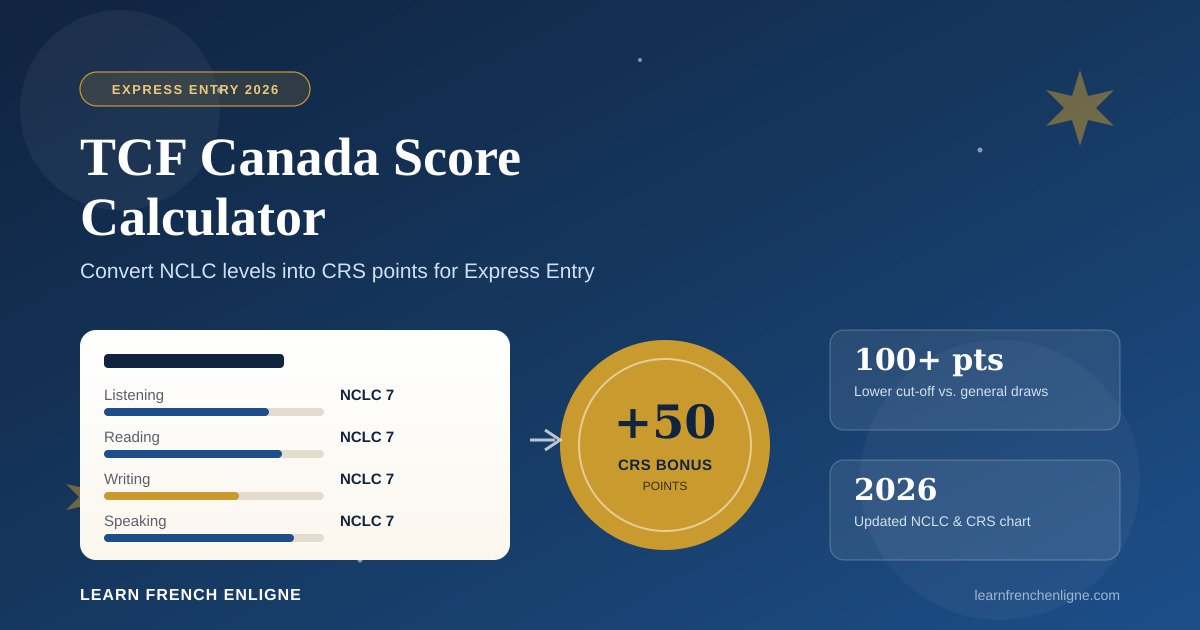
TCF Canada Score Calculator 2026: Convert Your NCLC Level Into CRS Points
A raw TCF Canada score means nothing to IRCC on its own. Here’s exactly how Listening, Reading, Writing and Speaking scores turn into NCLC levels — and how those levels turn into CRS points for Express Entry.
Updated for 2026 · 9 min read · By the LFE Team
If French is part of your Express Entry strategy, the TCF Canada score calculator is the tool that turns a page of raw numbers into a decision you can actually act on. Since IRCC removed job offer points from the Comprehensive Ranking System in March 2025, French proficiency has become one of the few remaining levers candidates can control — and one of the most powerful. French category draws have run with CRS cut-offs as low as the high 370s to low 400s through 2025 and 2026, compared with 500+ for general draws. That gap is often worth more than a master’s degree or several years of extra work experience.
The catch is that the TCF Canada certificate doesn’t hand you a CRS number, or even an NCLC level. It reports Listening and Reading on a 100–699 scale and Writing and Speaking on a 0–20 scale, tagged with CEFR (European framework) levels like B1 or B2. This guide walks through what a TCF Canada score calculator actually does, the full 2026 NCLC conversion table, and how your NCLC level maps onto Express Entry’s CRS points — including the bilingual bonus that’s currently worth up to 50 points.
What Is a TCF Canada Score Calculator?
A TCF Canada score calculator converts your raw results from the four mandatory sections of the Test de Connaissance du Français — Listening (Compréhension orale), Reading (Compréhension écrite), Writing (Expression écrite) and Speaking (Expression orale) — into the NCLC benchmark that Immigration, Refugees and Citizenship Canada (IRCC) actually uses to assess your profile.
The reason a calculator matters at all is that TCF Canada doesn’t use one uniform scale. Because the scales differ and IRCC assesses each skill independently rather than averaging them, you need to run each of your four scores through the official conversion table separately. That’s the entire job of a TCF Canada score calculator, whether it’s a spreadsheet, an online tool, or the manual method below.
TCF Canada Score vs. NCLC: Why the Two Don’t Match
NCLC stands for Niveaux de compétence linguistique canadiens — the French-language mirror of the Canadian Language Benchmarks (CLB) used for English. For CRS purposes, NCLC and CLB are treated as the same scale: NCLC 7 carries the same weight as CLB 7, just on the French side of the ledger.
Your TCF Canada certificate shows CEFR levels such as B1 or B2, which is a European framework, not the Canadian one IRCC uses. That’s the source of most confusion: candidates assume a “B2” result automatically means NCLC 7, but the two scales don’t line up 1:1 across every skill. A TCF to NCLC calculator exists specifically to close that gap using IRCC’s own correspondence chart before you submit anything to your Express Entry profile.
Your lowest NCLC level across all four skills is the level IRCC uses to assess your French proficiency — not your average and not your best score. Scoring NCLC 9 in three skills but NCLC 6 in one still leaves you at NCLC 6 overall for eligibility purposes.
TCF Canada Score Chart 2026: Full NCLC Conversion Table
The table below shows the score ranges IRCC uses to convert TCF Canada results into NCLC levels. Listening and Reading use slightly different breakpoints even though both sit on the same 100–699 scale, so always check the column that matches the specific skill you’re converting.
| NCLC Level | Listening (100–699) | Reading (100–699) | Writing (0–20) | Speaking (0–20) | CEFR |
|---|---|---|---|---|---|
| NCLC 4 | 331–368 | 342–374 | 4–5 | 4–5 | A2 |
| NCLC 5 | 369–397 | 375–405 | 6–7 | 6–7 | B1 |
| NCLC 6 | 398–457 | 406–452 | 8–9 | 8–9 | B1/B2 |
| NCLC 7 | 458–502 | 453–498 | 10–11 | 10–11 | B2 |
| NCLC 8 | 503–522 | 499–523 | 12–13 | 12–13 | B2/C1 |
| NCLC 9 | 523–548 | 524–548 | 14–15 | 14–15 | C1 |
| NCLC 10+ | 549–699 | 549–699 | 16–20 | 16–20 | C2 |
NCLC 7 is the number that matters most. It’s the minimum for the Federal Skilled Worker Program, the threshold for French category-based draws, and the entry point for the CRS bilingual bonus. Conversion tables are reviewed periodically, so always cross-check against the current figures on the official IRCC CRS criteria page before submitting your profile.
How to Use a TCF to NCLC Calculator, Step by Step
Whether you use an automated tool or do it by hand, a TCF to NCLC calculator follows the same logic an IRCC officer applies when reviewing your Express Entry profile:
Step 1: Pull your four raw scores
Locate the score for each section on your official TCF Canada attestation de résultats — Compréhension orale, Compréhension écrite, Expression écrite, Expression orale.
Step 2: Convert Listening and Reading separately
Match each score against its own column in the 100–699 table above. Do not reuse the Listening breakpoints for Reading — the ranges are close but not identical.
Step 3: Convert Writing and Speaking
Match each score against the 0–20 table. These two skills share identical breakpoints with each other.
Step 4: Assign an NCLC level to each skill individually
You’ll end up with four separate NCLC numbers. Resist the urge to average them — IRCC never does.
Step 5: Identify your lowest NCLC level
This is the number that determines your eligibility for the Federal Skilled Worker Program, French category draws, and the CRS bilingual bonus.
From NCLC to CRS: How French Adds Points to Express Entry
Once you know your NCLC level, the next step is translating it into CRS points under the Comprehensive Ranking System. French contributes to your score in two separate places, and mixing them up is one of the most common planning mistakes candidates make.
Core second-language points
If you declare French as your second official language, each of the four skills earns core CRS points on its own sliding scale, up to a combined maximum of 24 points without a spouse (22 points with one). Higher NCLC levels earn proportionally more — the jump from NCLC 6 to NCLC 7 is disproportionately large because it’s also the threshold that unlocks the bonus below.
The bilingual bonus: 25 or 50 points
This is the headline number, and it sits in a completely separate “additional points” bucket alongside things like a provincial nomination:
| French (NCLC) Result | English Result | CRS Bilingual Bonus |
|---|---|---|
| NCLC 7+ in all four skills | CLB 4 or lower / no English test on file | +25 points |
| NCLC 7+ in all four skills | CLB 5 or higher | +50 points |
The threshold is all-or-nothing: NCLC 7 in three skills and NCLC 6 in the fourth earns zero bonus points, regardless of how strong the other three results are. That’s exactly why running your results through a TCF Canada score calculator as soon as you receive them — rather than assuming a “good enough” pass — matters so much.
Why the gap matters more than it used to
Since IRCC permanently removed CRS points for arranged job offers in March 2025, French has become one of the few remaining strategies a candidate can actively control. Combined with dedicated French category-based draws, which have run at CRS cut-offs roughly 100+ points below general rounds through 2025 and 2026, a candidate who is a few points short of a general-draw invitation can often qualify through the French stream instead — without the bonus points changing anything about the rest of their profile.
Tips to Improve Your TCF Canada Score Calculator Results
- Sit a full-length practice test first. It reveals which of the four skills is realistically holding back your NCLC level before exam day.
- Treat all four skills as equally important. A strong Reading score cannot compensate for a weak Speaking score — each is judged independently.
- Re-run the calculator the moment your official report arrives. Don’t estimate; check your exact scores against the current table.
- Plan retakes early. If you’re one skill short of NCLC 7, book a retake as soon as possible — test-centre slots and the 15-working-day results turnaround can affect your Express Entry timeline.
- Submit both languages. Even a modest English result can be the difference between a 25-point and a 50-point bilingual bonus if your French already clears NCLC 7.
How LFE Prepares You for TCF Canada Success
Converting scores is the easy part — reaching NCLC 7 across all four skills is where most candidates need structured support. At Learn French Enligne (LFE), our Canada-focused programs are built specifically around the NCLC 7 threshold, not general fluency, so class time goes toward the skills that move your CRS score.
If you’re not sure how close you already are, our related guide on French course options for Canada PR breaks down which LFE program fits different starting levels, and our comparison of TCF Québec vs. TCF Canada is worth reading if you’re still deciding which exam to sit.
Not sure where your French stands right now?
Take LFE’s free placement test or book a short consultation — we’ll map your current level to the NCLC scale and tell you exactly how far you are from NCLC 7.
Frequently Asked Questions
How do I use a TCF Canada score calculator?
A TCF Canada score calculator takes your raw Listening, Reading, Writing and Speaking scores and matches each one against IRCC’s NCLC conversion table. Each skill is converted separately, and your lowest NCLC level across the four skills is the level IRCC uses for eligibility and CRS points.
What NCLC level do I need for Express Entry?
NCLC 7 in all four skills is the minimum for the Federal Skilled Worker Program, the French category draws, and the CRS bilingual bonus. Scoring NCLC 7 in three skills and NCLC 6 in the fourth does not qualify.
How many CRS points does French add to my profile?
NCLC 7 or higher in all four French skills adds a 25-point bilingual bonus if your English is CLB 4 or lower or absent, and a 50-point bonus if your English reaches CLB 5 or higher. These bonus points sit on top of the core second-language points your NCLC level already earns.
Is TCF Canada or TEF Canada better for Express Entry?
Both are approved by IRCC and convert to the same NCLC scale, so neither has an inherent scoring advantage. TCF Canada’s speaking section is often described as more conversational, while TEF Canada tends to have wider test-centre availability. Choose based on logistics and which format suits your strengths.
How long are TCF Canada results valid?
Two years from the test date. Your results must still be valid both when you submit your Express Entry profile and when you receive an Invitation to Apply, so time your test accordingly.
Related Reading
- IRCC – Express Entry: Comprehensive Ranking System (CRS) criteria
- IRCC – Express Entry: Category-based selection
- IRCC – Express Entry: Rounds of invitations
- France Éducation International – Official TCF Canada test information
Conversion tables and CRS bonus thresholds are set by IRCC and reviewed periodically. Always confirm current figures on the official pages above before submitting your Express Entry profile.
Written by the LFE Team · Learn French Enligne prepares candidates for TEF Canada, TCF Canada, DELF and DALF exams. Explore all courses →