French Course for Canada PR:
Your Complete 2026–2027 Guide
How learning French can add up to 50 CRS points to your Express Entry profile, unlock French-language draws, and make Canadian Permanent Residency a real and achievable goal.
Why French Is a Game-Changer for Canada PR in 2026
Canada is constitutionally bilingual under the Official Languages Act, but recent immigration policy goes well beyond symbolic bilingualism. The Canadian government has actively committed to increasing the proportion of French-speaking permanent residents outside Quebec — a policy goal that directly translates into immigration advantages for French-speaking applicants.
Through Canada’s Express Entry system, French proficiency rewards you in two distinct and stackable ways: additional bilingual CRS points (up to 50), and eligibility for French-language category-based draws where the invitation threshold is routinely lower than general draws.
The CRS Points Breakdown: Exactly How Much Can French Add?
The Comprehensive Ranking System awards bilingual bonus points based on your French level and your English level together. Here is exactly how it works:
| Your Situation | French Level (NCLC) | English Level (CLB) | Bonus CRS Points |
|---|---|---|---|
| Strong French, no English | NCLC 7+ | CLB 4 or below | 25 points |
| Strong French + solid English | NCLC 7+ | CLB 5+ | 50 points |
| Below threshold | Below NCLC 7 | Any | 0 points |
Most Express Entry applicants already have a CLB 5 or higher in English, meaning that reaching NCLC 7 in French unlocks the full 50-point bonus. To understand what NCLC 7 requires in practice, explore LFE’s guide on how to prepare for the TEF Canada exam and what score thresholds apply.
Real-World Profile Comparison
| Profile Factor | Candidate A | Candidate B |
|---|---|---|
| Education | Bachelor’s Degree | Bachelor’s Degree |
| Work Experience | 3 Years | 3 Years |
| English Score | CLB 9 | CLB 9 |
| French Score | None | NCLC 7 (CLB 7) |
| Estimated CRS Score | ~470 | ~520 |
| French-Language Draw Eligible? | No | Yes |
| ITA Prospects | Waiting in pool | Strong |
That 50-point gap is routinely the margin between staying in the Express Entry pool for months — or even years — and receiving an Invitation to Apply in the next draw. It is the single most impactful change most mid-range CRS applicants can make to their profile.
French Language Levels Explained: What You Need for Canada PR
French proficiency is measured internationally through the Common European Framework of Reference for Languages (CEFR), which defines six levels from A1 to C2. For Canadian immigration, your TEF Canada or TCF Canada result is converted into NCLC (Niveaux de compétence linguistique canadiens) levels, which are then used to calculate your CRS points.
| CEFR Level | Description | NCLC Equivalent | Immigration Relevance |
|---|---|---|---|
| A1 | Beginner | NCLC 1–2 | Starting point |
| A2 | Elementary | NCLC 3–4 | Basic communication |
| B1 | Intermediate | NCLC 5–6 | Some Francophone pathways |
| B2 | Upper Intermediate | NCLC 7–8 | Target: 50 CRS points + French draws |
| C1 | Advanced | NCLC 9–10 | Quebec + specialized pathways |
| C2 | Mastery | NCLC 11–12 | Full professional fluency |
LFE offers structured programmes at every stage of this journey — from the A1–A2 Beginner Course for those starting from scratch, through the A1–B1 Comprehensive Programme, up to full TEF Canada exam preparation targeting CLB 7.
Why B2 / NCLC 7 Is the Target for Canada PR
B2 is ambitious — but it is achievable and it is the level where immigration benefits become maximum. At B2 you can follow complex discussions, write structured arguments, participate in conversations on unfamiliar topics, and understand a wide range of authentic French audio and text. These are exactly the skills tested in the TEF and TCF Canada exams.
TEF Canada: Listening 280–298 | Reading 263–297 | Writing 393–467 | Speaking 393–467
TCF Canada: Listening 458–502 | Reading 499–542 | Writing 14–15 | Speaking 14–15
Always verify current score tables directly with IRCC, as conversion bands are periodically updated.
The Four Skills You Must Master
TEF Canada and TCF Canada both test all four language competencies with equal weight. Many candidates lose marks in speaking and writing by focusing only on reading and grammar. A balanced approach is essential:
- Listening — Follow native-speed conversations, interviews, announcements, and discussions on both familiar and unfamiliar topics
- Speaking — Express ideas confidently, justify opinions, and participate in structured monologue and dialogue tasks under time pressure
- Reading — Comprehend articles, formal correspondence, editorials, and informational texts across a range of registers
- Writing — Produce well-structured formal letters, argumentative essays, and descriptive responses with accurate grammar and appropriate vocabulary
TEF Canada vs TCF Canada: Which Exam Is Right for You?
Both exams are fully recognised by IRCC for all Express Entry streams and produce identical CRS outcomes. The difference is entirely in format, duration, and available preparation resources. LFE prepares students for both — see the TEF/TCF Canada coaching page for a full breakdown of what each programme covers.
| Feature | TEF Canada | TCF Canada |
|---|---|---|
| Accepted by IRCC | Yes | Yes |
| Skills Tested | Listening, Reading, Writing, Speaking | Listening, Reading, Writing, Speaking |
| Question Format | MCQ + Written + Oral | MCQ + Written + Oral |
| Total Duration | ~3 hrs 45 min | ~2 hrs 30 min |
| Prep Resources Available | Widely available | Available, fewer options |
| CRS Points Awarded | Same as TCF | Same as TEF |
| LFE Programme Available | TEF Canada 9-Month Course | TCF Canada 9-Month Course |
LFE also offers the TEF-TCF CLB 5 Accelerator (6 months) for applicants who need French proficiency primarily to extend their Canadian work permit before targeting PR — a common two-stage strategy.
Not Sure Which Exam to Take?
LFE’s expert team can assess your current French level and recommend the right programme and exam path for your immigration timeline.
How Long Does It Take to Learn French for Canada PR?
The honest answer depends entirely on where you start. Most adults learning French from zero need 8 to 14 months of structured, consistent study to reach B2 / NCLC 7. Here is a realistic timeline:
-
A1 Beginner — Months 1–2
Core vocabulary, pronunciation, verb conjugation basics, everyday phrases and questions. At this stage you can handle simple introductions and very familiar interactions. LFE’s A1–A2 Course covers this foundation efficiently. -
A2 Elementary — Months 3–4
Past and future tenses, shopping and travel vocabulary, short conversational exchanges, simple writing. You can handle routine tasks requiring a direct exchange of familiar information. -
B1 Intermediate — Months 5–7
Complex grammar structures, longer listening, expressing and justifying opinions, structured paragraph writing. You follow the main points of clear standard input on familiar matters. The A1–B1 Comprehensive Programme takes learners from zero to this stage. -
B2 Upper Intermediate — Months 8–12+
Nuanced reading and listening on abstract topics, coherent written arguments, spontaneous conversation. You’re operating at NCLC 7 — exam-ready for TEF/TCF Canada CLB 7. LFE’s 9-Month TEF Canada Mastery Program is designed to get you here with exam-specific coaching throughout.
LFE’s Courses for Canada PR: Find the Right Programme
Learn French Enligne (LFE) is a specialist online French school with 1,500+ enrolled students, a 96.5% learner satisfaction rate, and a curriculum designed specifically for immigration, certification, and professional goals. Every course includes live sessions, fortnightly mock tests, study materials, recordings of missed classes, free communication sessions, and level certificates.
TEF Canada Mastery Program
9-month live programme from A1 to CLB 7, specifically designed for Canada PR Express Entry applicants.
View Course →TCF Canada Mastery Program
9-month live programme targeting TCF Canada for Express Entry and Canada PR pathways.
View Course →TEF-TCF CLB 5 Accelerator
6-month accelerator for applicants needing CLB 5 to extend their Canadian work permit for two years.
View Course →French Mastery A1–B2 (Self-Paced)
Complete digital self-study path from absolute beginner to CLB 7 — study at your own pace.
View Course →A1–A2 Beginner Course
Start from zero with a structured beginner programme building all four language skills from the ground up.
View Course →A1–B1 Comprehensive Course
Foundational French from beginner to intermediate — the essential stepping stone before TEF/TCF prep.
View Course →LFE also offers DELF B1 and DELF B2 intensive programmes for learners targeting internationally recognised DELF/DALF certifications alongside or instead of TEF/TCF. Explore all options on the full courses page.
French Immigration Pathways Beyond Express Entry
French opens more than just CRS points. Here are the major immigration pathways where French proficiency gives you a structural advantage:
French-Language Category-Based Draws
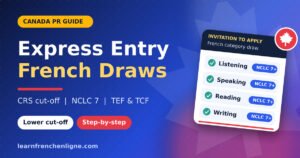
Since 2023, IRCC has run dedicated French-language Express Entry draws. These target candidates who demonstrate French proficiency (NCLC 7+) and have historically invited candidates at CRS scores 30–60 points below what was required in the same period’s general draws. This means even a CRS of 460–480, which would not receive an ITA in a general draw, may be sufficient in a French-language draw.
Francophone Mobility Work Permit
The Francophone Mobility stream allows French-speaking foreign nationals to obtain an open work permit in most Canadian provinces (outside Quebec) without requiring an LMIA. Canadian work experience then boosts your Express Entry CRS score further — creating a powerful compounding effect: French → work permit → Canadian experience → stronger Express Entry profile.
Quebec Immigration Programmes
Quebec manages its own immigration system through the Quebec Skilled Worker Program (QSWP). French is heavily weighted in Quebec’s selection grid and B2 is the practical minimum for competitive QSWP applications. LFE’s DELF B2 programme is directly relevant for Quebec-bound applicants. Read LFE’s blog on TCF Québec vs TCF Canada to understand which exam applies to your Quebec or federal PR pathway.
Rural and Northern Immigration Pilot (RNIP)
Several RNIP communities actively seek French-speaking candidates to support local Francophone populations. French proficiency at B1 or B2 level can make you a priority candidate in certain participating communities.
How to Study French Effectively for Canada PR
Choosing the right course is step one. How you study every day determines how fast you progress. LFE’s blog on blended French learning explores the most effective study methods in depth — here is a practical summary:
Build a Daily Immersion Habit
- Morning (15 min) — Listening practice: French podcast, radio news, or YouTube in French. Try RFI’s Journal en français facile for B1–B2 level authentic content
- Midday (20–30 min) — Structured study: grammar, vocabulary building, reading practice from your LFE course materials
- Evening (15–20 min) — Active production: writing a short paragraph, or a speaking practice session with your LFE tutor or a language partner
Prioritise Speaking from Day One
Speaking is the skill most candidates neglect — and the one that loses the most marks on TEF/TCF. LFE’s programmes include free communication sessions and live group speaking classes specifically to address this. Start speaking in French from A2, even imperfectly. Comfort with spoken French does not come from studying grammar — it comes from speaking regularly over time.
Use Mock Tests Strategically
LFE provides fortnightly mock tests as a core part of every programme. Take your first full mock at the B1 stage — not to pass, but to understand the exam’s rhythm, timing, and question types. After each mock, analyse your scores by skill and direct your next two weeks of study toward your weakest area. LFE also provides free TEF prep resources through the TEF-TCF Canada coaching hub.
Use Free LFE Resources
- Download free grammar worksheets covering the B1–B2 structures most frequently tested on TEF Canada
- Attend LFE’s free live webinars with expert tutors for exam strategy and Q&A
- Access DELF/DALF study guides and mock test resources on the free resources page
- Take the free placement test to know your exact level before starting any course
Frequently Asked Questions
Start Your French Journey for Canada PR Today
Join 1,500+ learners at LFE with expert-led live courses, fortnightly mock tests, free speaking sessions, and a curriculum built specifically for Express Entry and Canada PR success.
Related Articles from LFE Blog
- IRCC — Express Entry: How It Works
- IRCC — Category-Based Selection Draws (2026)
- IRCC — Francophone Mobility Work Permit
- MIFI Québec — Quebec Skilled Worker Program
- IRCC — Rural and Northern Immigration Pilot
- Council of Europe — Common European Framework of Reference (CEFR)
- Government of Canada — Official Languages Act
This article is for informational purposes only and does not constitute immigration legal advice. CRS point values, draw thresholds, and IRCC policies are subject to change. Always verify immigration requirements directly with IRCC or a licensed immigration consultant (RCIC).