How to Prepare for the TEF Canada Exam in 2026
Everything you need to know — exam format, CLB levels, study timelines, section tips, and the fastest path to CLB 7.
1. What Is the TEF Canada Exam?
If you are planning your TEF Canada exam preparation, understanding what the test actually is comes first. The Test d’Évaluation de Français (TEF) Canada is an internationally recognised French language proficiency test created by the Paris Île-de-France Chamber of Commerce and Industry. It is one of only two language tests — the other being the TCF Canada — officially accepted by Immigration, Refugees and Citizenship Canada (IRCC) for immigration and citizenship applications.
If you are applying for Canadian Permanent Residency (PR), a work permit extension, the Quebec Selection Certificate (CSQ), or Canadian Citizenship, passing the TEF Canada at the required CLB level is a mandatory step. The exam evaluates your proficiency across four skills: listening, reading, writing, and speaking.
2. TEF Canada Exam Format & Components
Understanding the structure of the exam is the first step in building an effective preparation plan. The TEF Canada consists of four mandatory sections:
| Section | French Name | Duration | Questions/Tasks |
|---|---|---|---|
| Listening Comprehension | Compréhension Orale | ~40 min | 40 multiple-choice questions |
| Reading Comprehension | Compréhension Écrite | 60 min | 50 multiple-choice questions |
| Written Expression | Expression Écrite | 60 min | 2 writing tasks |
| Oral Expression | Expression Orale | ~15 min | 2 speaking tasks |
3. What French Level Do You Need for TEF Canada?
The most common immigration requirement is CLB 7, which is equivalent to the B2 level on the CEFR (Common European Framework of Reference). This level demonstrates that you can handle complex French conversations, understand nuanced written material, and express yourself clearly and fluently.
For the CLB 5 requirement — typically needed for a two-year work permit extension — a B1+ level of French is sufficient. The table below maps CLB levels to CEFR equivalents:
| CLB Level | CEFR Equivalent | Use Case |
|---|---|---|
| CLB 4–5 | A2–B1 | Work permit extension (2 years) |
| CLB 7 | B2 | Canadian Permanent Residency (Express Entry) |
| CLB 9 | C1 | Higher Express Entry points |
| CLB 10 | C1–C2 | Maximum points in language assessment |
4. How Long Does TEF Canada Exam Preparation Take?
Successful TEF Canada exam preparation depends heavily on your current French proficiency. Here is a realistic timeline for most learners:
If you already have a B1 foundation, 4–6 months of structured TEF-specific preparation may be enough to clear CLB 7. Learners who already hold B2 may need just 2–3 months of exam-strategy practice and mock tests.
The single biggest factor, beyond raw study hours, is the quality of guidance you receive. Working with an experienced TEF instructor who knows the scoring criteria and common examiner patterns can cut months from your preparation time. LFE’s 9-month TEF Canada Mastery Program is designed specifically around this principle.
5. Step-by-Step TEF Canada Exam Preparation Study Plan
Here is a structured TEF Canada exam preparation approach that covers the essentials without wasting time:
Take a free placement test or a mock TEF to identify your current proficiency. Without knowing your baseline, you cannot build an efficient study plan. LFE’s free placement test gives you a reliable starting point.
Decide whether you need CLB 5 (work permit) or CLB 7 (PR). Register for your exam date in advance — aim for at least 8–12 weeks of focused prep time after enrolment.
Build solid grammar, vocabulary, and phonetics before tackling TEF-specific content. LFE’s A1–B1 Fast-Track Course covers these systematically. Also explore the free grammar worksheets on LFE.
Shift to TEF-format materials: timed listening exercises, past reading papers, TEF writing prompts, and structured speaking practice. Enrol in a dedicated TEF Canada preparation course for guided, exam-aligned learning.
Simulate real exam conditions every two weeks. Review your weak sections in detail. LFE runs fortnightly mock tests for enrolled students, with detailed examiner-style feedback on writing and speaking tasks.
Focus on time management, question elimination strategies for MCQs, and polishing your spoken expression. Stop learning new grammar at this stage — consolidate what you know.
6. Preparation Tips for Each TEF Section
🎧 Listening Comprehension
This section tests your ability to understand natural spoken French across accents, speeds, and contexts. Daily immersion is the most effective preparation: listen to RFI (Radio France Internationale), France Inter, or the Journal en Français Facile podcast. Watch French YouTube channels like Français Authentique with and without subtitles. The goal is to understand French without mentally translating every word.
📖 Reading Comprehension
Read French daily — news articles from Le Monde, Le Figaro, or TV5Monde are ideal. TEF reading passages often test inference and vocabulary in context, not just literal meaning. Practice skimming for main ideas and scanning for specific details, as the 60-minute window allows roughly 70 seconds per question on average.
✍️ Written Expression
The two writing tasks typically require a formal letter or email and an opinion essay. Practice both formats under timed conditions. Pay attention to task completion (have you addressed all sub-points?), cohesion (logical paragraph flow), and register (formal vs informal language). Use platforms like LFE’s free DELF/TEF preparation resources to review writing rubrics and model responses.
🗣️ Oral Expression
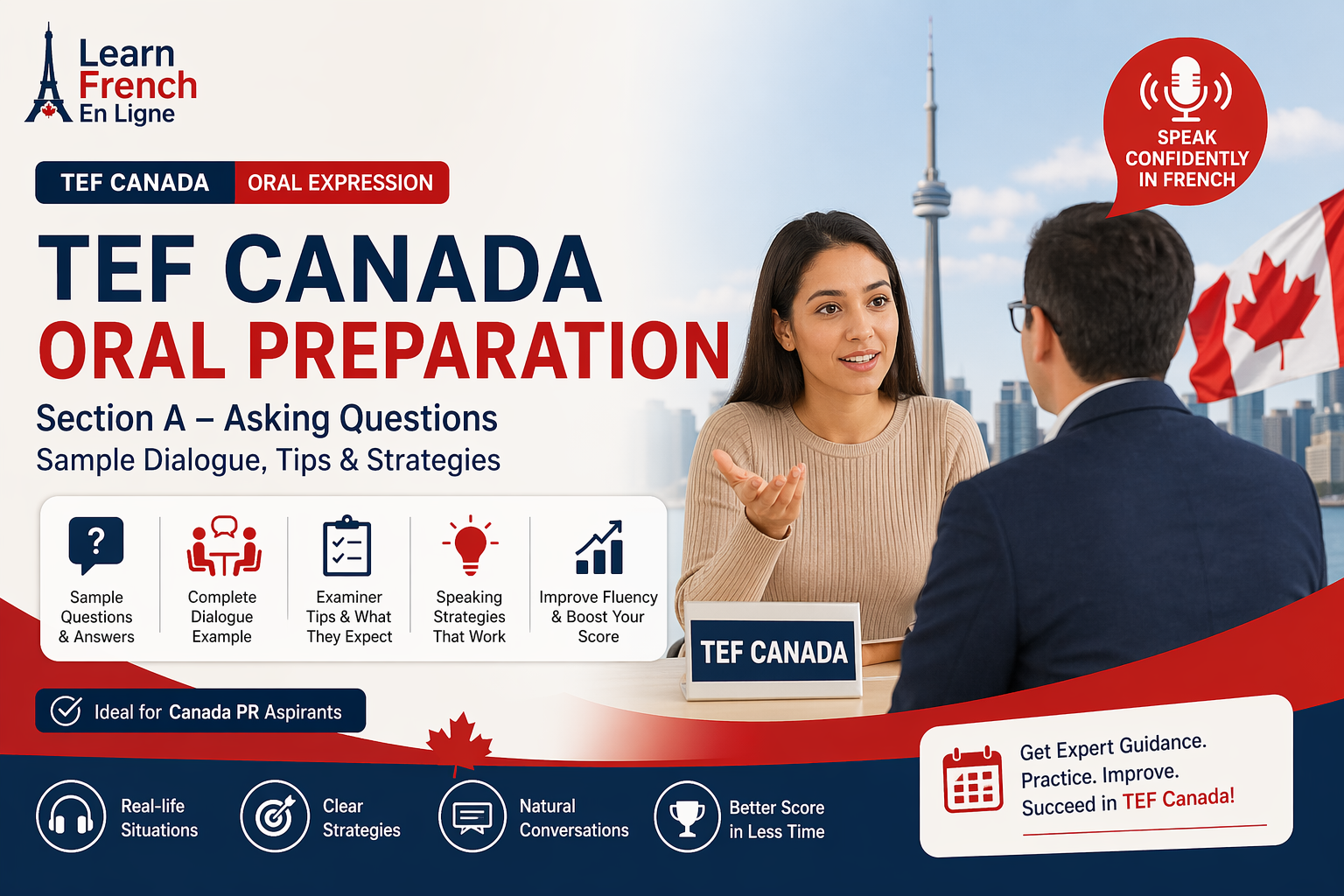
Many test-takers lose points here due to nervousness, not lack of vocabulary. Consistent speaking practice — ideally with a native or advanced speaker — is essential. LFE offers free communication sessions for enrolled students. Practice the two speaking task formats: a structured presentation and a discussion/debate, both on current or everyday topics. Record yourself and critically review your fluency, pronunciation, and coherence.
7. Common Mistakes to Avoid During TEF Preparation
- Starting TEF prep without a B1 foundation. Jumping into exam practice before mastering core grammar and vocabulary is one of the most common — and expensive — mistakes. Build the foundation first.
- Neglecting the speaking section. Many self-studiers focus entirely on reading and listening, then underperform on oral expression. Speaking must be practised regularly with real feedback.
- Ignoring the timer during practice. The TEF is a timed exam. Doing practice questions without a clock gives you a false sense of readiness.
- Relying only on general French apps. Apps like Duolingo are useful for vocabulary, but they do not replicate the TEF exam format or scoring criteria. You need TEF-specific training.
- Not reviewing mock test feedback properly. Taking mock tests without deeply analysing your mistakes yields little improvement. Spend as long reviewing errors as you did completing the test.
- Leaving registration too late. Popular TEF test centres fill up weeks in advance, especially before Express Entry draw deadlines. Register early.
8. How to Register for TEF Canada
Registration is straightforward but must be done in advance. Here is the process:
Visit the official TEF Canada website to locate certified test centres near you. In India, authorised centres include Alliance Française branches across major cities.
Fill out the registration form at your chosen centre at least one week before your desired test date. Many centres require payment at the time of registration to confirm your slot.
You will receive a confirmation email within 72 hours of payment. Keep this for your records — it may be required for entry on exam day.
Bring a valid passport or two photo IDs, your test invitation (digital or printed), and headphones if your centre requires them for the listening section.
9. Online vs Offline TEF Canada Exam — Which Should You Choose?
In 2026, TEF Canada is available in both formats. Your choice should depend on your personal test-taking style and available resources:
| Format | Best For | Considerations |
|---|---|---|
| Online (at home) | Candidates with a stable internet connection who perform well in their own environment | Requires a quiet, private space; technical setup must be tested in advance |
| Offline (test centre) | Candidates who prefer a structured, supervised environment | Travel to centre required; test centre ambiance can reduce distractions |
Both formats use the same TEF exam structure, scoring rubric, and CLB mapping. Your score will be identical regardless of which format you choose. Practise under whichever conditions match your exam-day environment.
10. Best Online Courses for TEF Canada Exam Preparation
Learn French Enligne (LFE) is a dedicated online French school offering structured, examiner-led TEF Canada exam preparation programs. With over 1,500 enrolled students and a 96.5% satisfaction rate, LFE is one of the most trusted platforms for TEF and TCF Canada preparation. Here are the programs most relevant to TEF aspirants:
The flagship course at LFE — comprehensive coverage from foundations to CLB 7, with fortnightly mock tests, 24/7 chat support, recordings of missed classes, and certificate at each level.
Designed for candidates who need CLB 5 to extend their work permit by two years. A faster, more focused path for those with an existing A2–B1 foundation.
Build the essential French foundations before beginning TEF-specific training. Ideal for learners starting from scratch or below A2 level.
If you want to simultaneously obtain the internationally recognised DELF B2 diploma while preparing for TEF CLB 7, this program — led by an official examiner — is ideal.
Ready to Start Your TEF Canada Journey?
Over 1,500 learners have trusted LFE to guide them to their target CLB score. Get expert-led instruction, fortnightly mock tests, and certified support — all online.