TCF Québec vs TCF Canada:
The Complete Difference Guide
Before you book your exam, make sure you’re booking the right one. These two tests have the same name family — but they open completely different doors.
Every year, thousands of French learners begin their Canadian immigration journey by typing “TCF exam” into a search engine — and then booking the wrong one. TCF Québec and TCF Canada are administered by different authorities, accepted by different programs, and structured differently. Mixing them up can cost you weeks, money, and potentially your immigration application.
This guide — written for readers of LearnFrenchEnLigne — breaks down every meaningful difference so you can walk into your exam centre with total confidence.
What Is TCF Canada?
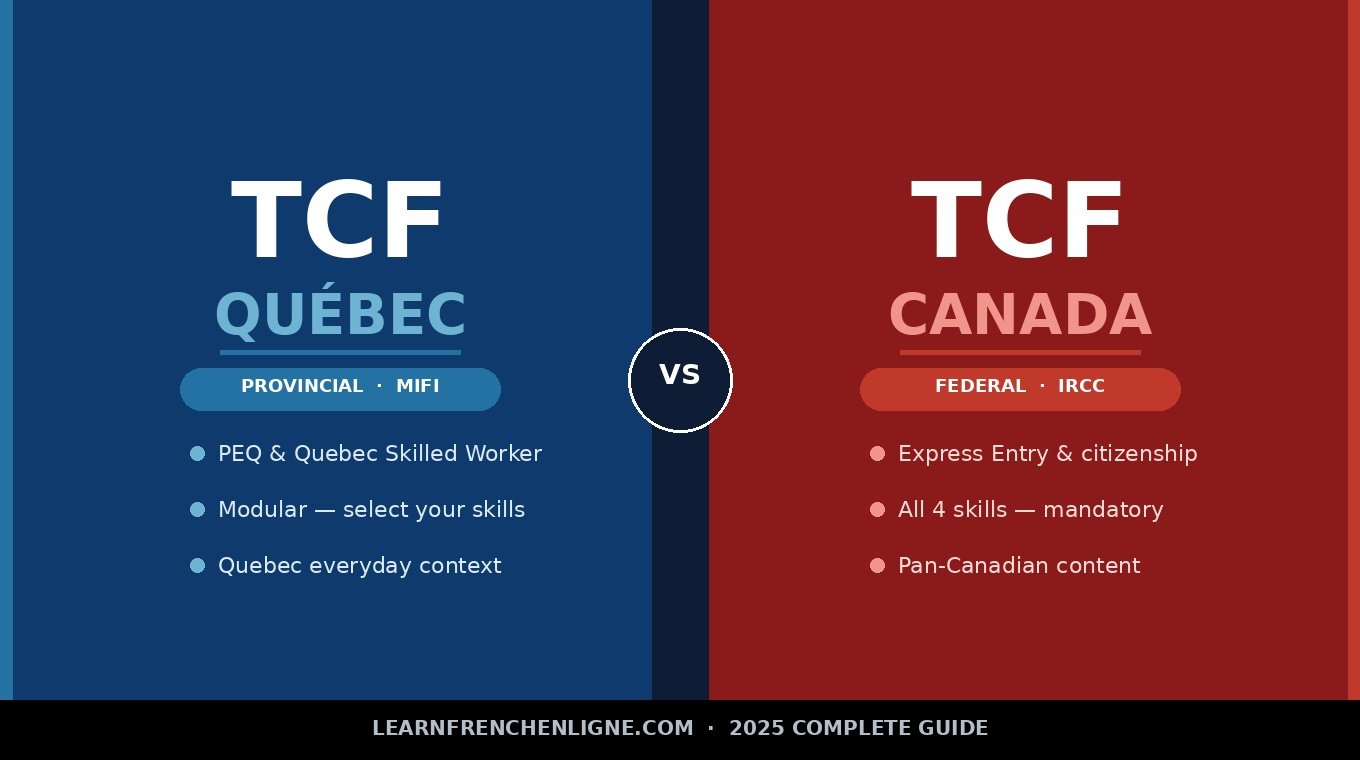
TCF Canada — officially Test de Connaissance du Français pour le Canada — is administered jointly by France Éducation International (FEI) and Immigration, Refugees and Citizenship Canada (IRCC). It is the recognized French language test for federal immigration pathways.
Who needs TCF Canada?
- Applicants to Express Entry (Federal Skilled Worker, Federal Skilled Trades, Canadian Experience Class)
- People applying for Canadian citizenship who need to prove French language ability
- Candidates seeking the French-language CRS bonus or applying via the Francophone community draws
- Anyone applying to a province outside Quebec through the Provincial Nominee Program (PNP) that requires federal language proof
What does TCF Canada test?
Unlike its sibling exam, TCF Canada has no modular option. All four skills are mandatory in a single sitting:
Score: 100–699
Score: 100–699
Assessed separately
Assessed separately
All scores are converted into NCLC (Niveaux de compétence linguistique canadiens) levels from 1 to 12, which are then used to calculate your Comprehensive Ranking System (CRS) score for Express Entry. A strong TCF Canada result across all four skills is one of the most efficient ways to boost your CRS. To learn more about how French language ability affects your CRS, read our guide: How French Language Boosts Your Express Entry CRS Score.
What Is TCF Québec?
TCF Québec is administered by the Ministère de l’Immigration, de la Francisation et de l’Intégration (MIFI) — Quebec’s own provincial immigration authority. It exists to evaluate French language proficiency for candidates applying through Quebec-specific programs.
Who needs TCF Québec?
- Applicants to the Programme de l’expérience québécoise (PEQ)
- Candidates in the Quebec Skilled Worker Program (QSWP / Programme régulier des travailleurs qualifiés)
- Students or workers already in Quebec who must prove French proficiency for permanent selection
- Anyone whose immigration pathway is provincially administered by MIFI, not IRCC
What makes TCF Québec different in structure?
The key structural advantage of TCF Québec is its modular registration. Candidates register only for the components their specific program requires — for instance, a PEQ applicant may only need oral comprehension and oral expression, making the exam faster and less expensive. This flexibility makes TCF Québec an appealing option for candidates who already have strong written French from their professional life in Quebec.
TCF Québec vs TCF Canada: Key Differences Explained
Here is a clear comparison of every meaningful factor that separates the two exams:
| Factor | Federal TCF Canada | Québec TCF Québec |
|---|---|---|
| Administered by | France Éducation International + IRCC | Quebec Ministry of Immigration (MIFI) |
| Immigration purpose | Express Entry, federal PR, citizenship | PEQ, QSWP, Quebec-specific selection |
| Skills tested | All four mandatory — no choice | Modular — select only what your program requires |
| Content focus | Pan-Canadian everyday and professional themes | Quebec daily life, culture, and professional context |
| Score scale | 100–699 (listening/reading); rubric-based (speaking/writing) | Same CEFR-aligned scale; module-specific outputs |
| Converted to | NCLC levels 1–12 | NCLC levels 1–12 (Quebec equivalent) |
| Score validity | 2 years from test date | 2 years from test date |
| Test centres | Authorized FEI centres worldwide | Authorized Quebec test centres (MIFI approved) |
| Can results be swapped? |