
DELF A2 · PRODUCTION ORALE
Entraînez-vous avec des situations de la vie quotidienne, des questions et des réponses modèles pour développer votre expression orale en français.
DELF A2 · ÉPREUVE ORALE
Dans cette partie de l’oral du DELF A2, le candidat s’exprime seul pendant quelques minutes sur un sujet de société. Voici 4 questions fréquentes, chacune suivie d’un monologue complet à titre d’exemple.
DELF A2 · PRODUCTION ÉCRITE-
Répondre à une lettre annonçant une naissance : féliciter, demander conseil pour un cadeau, et poser des questions sur la famille. Voici la lettre reçue, la consigne, puis une réponse modèle complète.
DELF A2 · PRODUCTION ÉCRITE-Conseiller une destination de vacances
Répondre à un ami pour lui conseiller un lieu de vacances, décrire l’endroit et raconter ce qu’on y a fait : un exercice courant du DELF A2. Voici le mail reçu, la consigne, puis une réponse modèle complète.
DELF A2 · PRODUCTION ÉCRITE
Vous avez fait un voyage d’une semaine à Paris. Vous racontez dans votre journal personnel ce que vous avez fait, jour après jour. Vous parlez de vos impressions sur la vie à Paris. Écrivez un texte de 60 à 80 mots.
DELF B1 Production Écrite

Le tourisme durable est un excellent thème pour s’entraîner à présenter une opinion, développer des arguments, proposer des solutions et utiliser un vocabulaire lié à l’environnement, à la culture et à l’économie.
Dans cet exercice, vous allez découvrir le sujet complet, une réponse modèle corrigée, les erreurs à éviter, du vocabulaire utile et une méthode simple pour organiser votre production écrite.
DELF B1 Production Écrite : Exemple Corrigé sur “
La production écrite du DELF B1 inquiète beaucoup de candidats. En 45 minutes, il faut présenter un point de vue personnel de manière claire, organisée et suffisamment développée. La production écrite comporte au minimum 160 mots.
Dans cet article, nous allons travailler sur un thème très utile pour votre préparation au DELF B1 : les impacts positifs et négatifs de la technologie sur notre vie quotidienne.
DELF B1 Production Écrite : Sujet et Réponse Corrigée
Voici un sujet type de production écrite du DELF B1, accompagné de la réponse réelle d’un candidat et de sa correction complète, phrase par phrase. C’est exactement le format d’entraînement que nous utilisons pour préparer nos candidats à l’épreuve écrite du DELF B1 — chaque erreur est expliquée sous forme de question/réponse, comme le ferait un examinateur, en complément d’outils de pratique comme learnfrenchenligne.com.
French Liaison Rules Made Simple: When to Link Words and When Not To
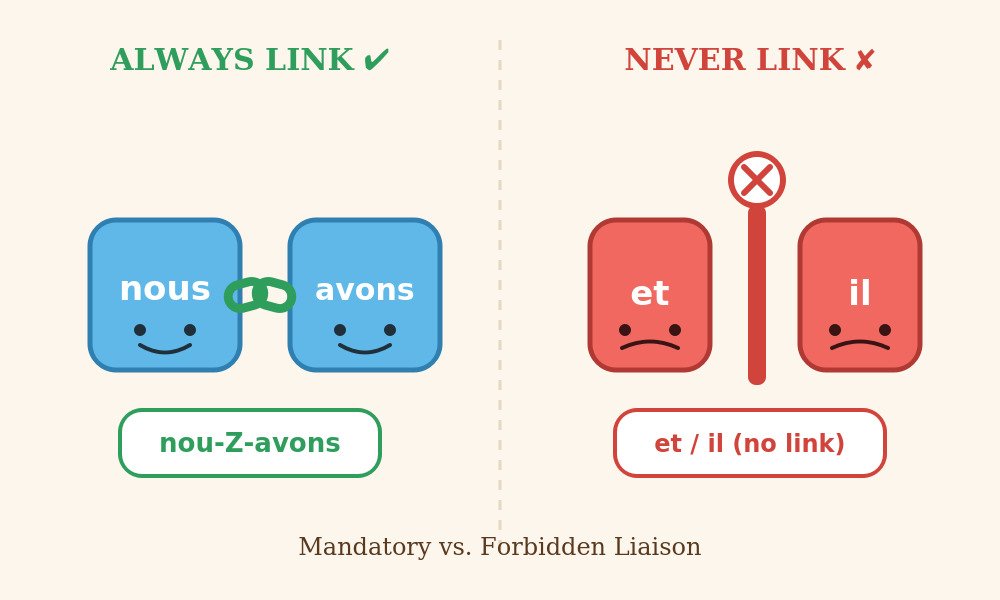
If you’ve ever paused a French podcast, rewound a sentence three times, and still couldn’t figure out where one word ended and the next one began — you’ve met liaison. It’s one of the biggest reasons spoken French sounds nothing like the French you read in a textbook, and it’s exactly why the jump from B1 to B2 feels like hitting a wall.
Vivre sans télévision : stratégie et exposé-modèle- DELF B1

Dans l’Exercice 3 du DELF B1, vous recevez un court document (article, encadré, publicité…) et devez en dégager le thème, puis présenter votre opinion pendant environ 3 minutes. L’examinateur vous posera ensuite quelques questions. Voici la méthode à suivre pendant vos 10 minutes de préparation et pendant l’exposé lui-même.