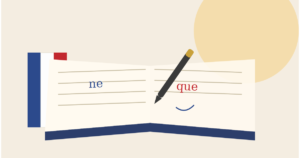

Vous voulez que je sois patient? Il faut que j’apprenne le subjonctif. If that sentence made you pause, you are not alone — the French subjunctive mood (le subjonctif) is the single grammar point that trips up the most DELF B2 and TCF Canada candidates. It does not follow a simple time-based logic like the passé composé or the imparfait; instead, it depends on the feeling behind a sentence — doubt, desire, emotion, necessity. Once you understand the logic, though, it becomes one of the most predictable structures in French.
This guide breaks down exactly when to use the subjunctive, how to conjugate it, and how it is tested in the DELF/DALF exam, so you can stop guessing and start applying the rule with confidence.

Photo: Pexels (free to use)
What Is the French Subjunctive Mood?
In grammar, a “mood” tells you the speaker’s attitude toward what they are saying. French has four main moods: the indicatif (facts), the conditionnel (hypotheses), the impératif (commands), and the subjonctif — used for anything that is uncertain, wished-for, feared, or judged, rather than stated as objective fact.
Indicative vs Subjunctive: The Key Difference
Compare these two sentences:
- Indicative (fact): Je sais qu’il vient. — I know he is coming. (Certain.)
- Subjunctive (feeling): Je veux qu’il vienne. — I want him to come. (Wished for, not guaranteed.)
Notice the verb changes from vient to vienne. That shift is the subjunctive doing its job — signalling that the second clause is not a confirmed fact, only a wish.
When Do You Use the Subjunctive in French? (The Triggers)
You almost never need to guess whether the subjunctive is required — it is triggered by specific expressions that come before the word “que.” Learn these trigger groups and the mood becomes automatic.
1. After Verbs of Wish, Will and Preference
vouloir que, souhaiter que, aimer que, préférer que, désirer que
Example: Le professeur veut que nous fassions nos devoirs. (The teacher wants us to do our homework.)
2. After Verbs and Expressions of Doubt or Emotion
douter que, avoir peur que, être content/triste/surpris que, regretter que
Example: J’ai peur qu’il ne soit trop tard. (I’m afraid it might be too late.)
3. After Impersonal Expressions of Necessity or Possibility
il faut que, il est possible que, il est important que, il vaut mieux que, il semble que
Example: Il faut que tu sois à l’heure pour l’examen DELF. (You must be on time for the DELF exam.)
4. After Certain Conjunctions
bien que (although), avant que (before), pour que / afin que (so that), à moins que (unless), jusqu’à ce que (until), sans que (without)
Example: Elle étudie tous les jours bien qu’elle soit déjà au niveau B2. (She studies every day although she is already at B2 level.)
How to Conjugate the Present Subjunctive
Regular -er, -ir and -re Verbs
Take the ils/elles form of the present indicative, drop -ent, and add the subjunctive endings: -e, -es, -e, -ions, -iez, -ent.
| Pronoun | parler | finir | vendre |
|---|---|---|---|
| que je | parle | finisse | vende |
| que tu | parles | finisses | vendes |
| qu’il/elle | parle | finisse | vende |
| que nous | parlions | finissions | vendions |
| que vous | parliez | finissiez | vendiez |
| qu’ils/elles | parlent | finissent | vendent |
Irregular Subjunctive Verbs You Must Memorise
| Verb | que je | que nous |
|---|---|---|
| être | sois | soyons |
| avoir | aie | ayons |
| faire | fasse | fassions |
| aller | aille | allions |
| pouvoir | puisse | puissions |
| savoir | sache | sachions |
| vouloir | veuille | voulions |
For a deeper breakdown of stem-changing and doubly irregular verbs, Lawless French’s subjunctive conjugation lessons are an excellent free reference to practise alongside your Lingua Nest classes.

Photo: Pexels (free to use)
Subjunctive vs Indicative: Quick Comparison Table
| Situation | Mood Used | Example |
|---|---|---|
| Stating a fact | Indicative | Je pense qu’il a raison. |
| Expressing doubt | Subjunctive | Je ne pense pas qu’il ait raison. |
| Certainty (savoir que, être sûr que) | Indicative | Je suis sûr qu’elle vient. |
| Wish or emotion | Subjunctive | Je suis content qu’elle vienne. |
Common Mistakes Indian Learners Make with Le Subjonctif
- Using the subjunctive after “espérer que”: Unlike most wish-verbs, espérer que takes the indicative — “J’espère qu’il vient,” not “vienne.”
- Forgetting the two-subject rule: The subjunctive only appears when the subject of the two clauses is different. If the subject is the same, use the infinitive instead: “Je veux partir,” not “Je veux que je parte.”
- Overusing “il faut que” in spoken exams: It’s correct, but relying on only one trigger phrase limits your score on the DELF B2 production écrite section, where examiners look for a range of structures.
- Mixing up “bien que” with “parce que”: “Parce que” (because) always takes the indicative; only “bien que” (although) takes the subjunctive.
The Subjunctive in Your DELF B2 and TCF/TEF Canada Exam
Why Examiners Test It
At B2 level, examiners expect you to argue, express opinion, and qualify your statements — exactly what the subjunctive is built for. It shows up constantly in the DELF/DALF written and spoken sections, and strong control of it is one of the clearest markers separating a B1 candidate from a true B2 candidate. It also appears in the more formal register tested in the TEF Canada 2026 exam, particularly in the expression écrite tasks.
Practice Sentences With Answers
- Il est essentiel que vous ______ (comprendre) cette règle avant l’examen.
Answer: compreniez - Je doute qu’il ______ (savoir) la réponse.
Answer: sache - Bien qu’elle ______ (être) fatiguée, elle continue à étudier.
Answer: soit - Nous cherchons un professeur qui ______ (pouvoir) nous aider en grammaire.
Answer: puisse
Quick Practice Exercise
Try completing these on your own before checking the answer key above the CTA section:
- Il faut que tu ______ (finir) ce chapitre avant demain.
- Je suis surpris que vous ______ (ne pas venir) hier.
- Pour que nous ______ (réussir) le DELF B2, il faut pratiquer chaque jour.

Photo: Pexels (free to use)
Frequently Asked Questions
Is the French subjunctive hard to learn?
It looks intimidating at first because it isn’t tense-based like English tenses, but once you memorise the trigger phrases and a handful of irregular stems, applying it becomes largely automatic — especially with regular daily practice.
Do I need the subjunctive for DELF A1 or A2?
No. The subjunctive is formally introduced from B1 onward and becomes essential from B2, where examiners expect you to express opinion, doubt and necessity fluently.
What is the easiest way to remember subjunctive triggers?
Group them by theme — wish, doubt, emotion, necessity, and certain conjunctions — rather than memorising a random list. The WEIRDO acronym above is a useful shortcut.
Is there a subjunctive past tense?
Yes — the subjonctif passé, used for actions that happened before the main clause’s action, e.g. “Je suis content qu’il ait réussi.” It follows the same trigger rules as the present subjunctive.
Master Le Subjonctif With Structured DELF B2 & TEF Canada Coaching
Reading rules is only half the battle — real fluency with the subjunctive comes from speaking it out loud, correcting your mistakes, and practising with exam-format questions. At Lingua Nest, our French for Canada PR (TEF/TCF) batches include grammar-focused mock tests on the PrepMyFuture platform, small batches of max 8 students, and trainers who correct your subjunctive usage sentence by sentence.
Reference: France Éducation International, the official body administering the DELF/DALF examinations for the French Ministry of Education.