
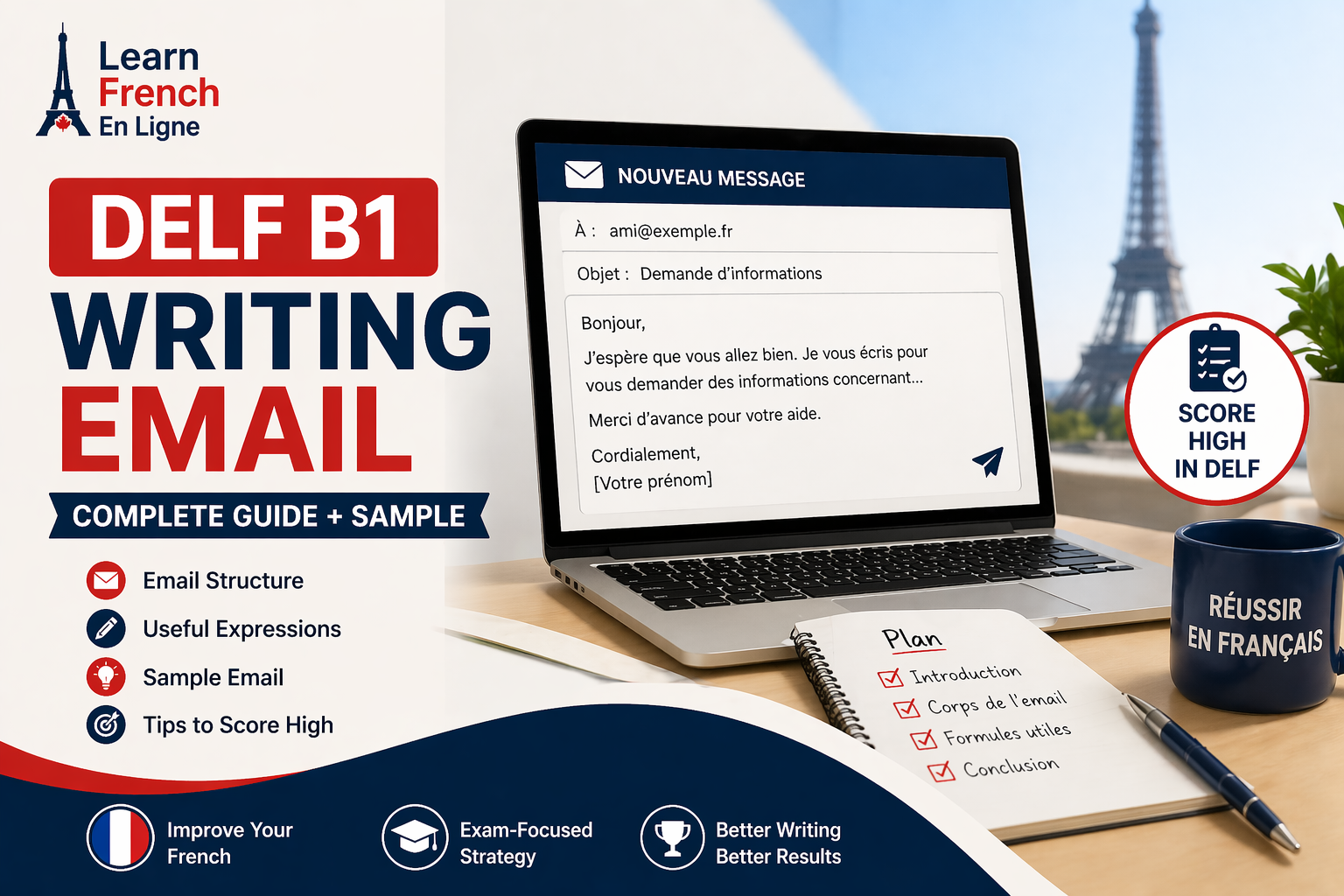
How to Write a Perfect Informal Email for DELF B1
Full breakdown of the email writing task — format rules, required content points, key grammar structures, and a fully annotated model answer with 180+ words.
Understanding the Prompt: Raphaël’s Dilemma
Before you write a single word, you need to understand exactly what the task is asking. In DELF B1 written production, the email task always gives you a prompt email to read — this is the message your fictional friend has sent you. Your job is to reply to it fully and naturally, as a real friend would.
Here is the original email from Raphaël that you need to respond to:
Cher Laurent,
Comment vas-tu ? Chez nous tout le monde va bien ! La nouveauté c’est que ma femme et mes enfants veulent absolument qu’on quitte la capitale et qu’on aille s’installer à la campagne, alors que moi je n’aime que Paris ! Ici, j’ai un bon poste. Ma famille et mes amis habitent tous ici. Nous sortons tous les weekends et j’ai beaucoup d’activités. À la campagne, en général, je m’ennuie : il n’y a rien à faire, à part des promenades !
Mais ils insistent vraiment et je ne sais plus quoi faire. Qu’en penses-tu ?
À très vite,
Raphaël
The task instructions are clear: reply to Raphaël, give him your opinion, and share personal experiences — either your own or those of friends who have made this kind of choice. Your reply must be at least 160 words.
The Four Content Points You Must Cover
DELF B1 examiners use a detailed marking grid. Your email will be checked against four specific content points. Missing any one of them costs you points. Here is exactly what you need to include:
-
1
An appreciation of Raphaël’s situation. Acknowledge his feelings. Show empathy. Examples: “C’est une grande décision à prendre, je comprends que tu hésites.” or “C’est normal que tu te poses des questions !” — This validates his emotions and opens the conversation naturally.
-
2
A suggested compromise solution. Don’t simply take one side. Find a middle ground between what Raphaël wants and what his family wants. Examples: “Tu pourrais garder un studio à Paris et partager ton temps entre les deux endroits.” or “Vous n’êtes pas obligés de partir très loin.”
-
3
A personal or shared experience. Tell a story — your own or a friend’s. Use past tenses (passé composé, imparfait, plus-que-parfait). This is where you demonstrate narrative ability. Examples: “J’ai un couple d’amis qui a fait ce choix…” or “Moi aussi, j’avais des préjugés sur la campagne avant d’y habiter.”
-
4
A piece of advice. Use conditional or subjunctive phrases to recommend something concrete. Examples: “À ta place, je tenterais d’abord un séjour d’un mois à la campagne.” or “Si j’étais toi, je prendrais le temps de réfléchir à des solutions alternatives.”
Format Rules — Don’t Lose Easy Marks
Scoring Breakdown
Complete Sample Email (Annotated)
The email below is a full model answer at DELF B1 level. It covers all four required content points, uses the correct format, and demonstrates the grammar structures examiners want to see. Coloured underlines highlight the key language features — use the legend below to decode them.
Cher Raphaël,
Quel plaisir de recevoir de tes nouvelles ! Je comprends vraiment que tu sois perdu face à cette décision — en effet, choisir entre sa vie parisienne bien établie et les souhaits de sa famille, c’est une situation vraiment difficile. Il me semble que tu aies tout à fait raison de prendre le temps d’y réfléchir !
Cela dit, je te suggérerais de ne pas choisir entre l’un et l’autre, mais plutôt d’envisager un double domicile : un appartement à Paris pour la semaine, et une maison à la campagne pas trop éloignée pour le week-end. Ainsi, tu pourrais garder ton poste et tes amis tout en offrant à ta famille l’espace et la nature qu’ils souhaitent.
J’ai justement un couple d’amis, Marc et Céline, qui ont fait ce choix il y a deux ans. Au début, Céline ne voulait absolument pas quitter Paris — elle avait toujours vécu dans la capitale et n’imaginait pas sa vie ailleurs. Finalement, ils ont opté pour une maison en Normandie, à seulement deux heures de Paris. Céline a complètement changé d’avis : elle m’a dit qu’elle n’avait jamais été aussi heureuse, et que ses enfants s’épanouissent beaucoup plus qu’avant.
À ta place, j’essaierais d’abord un séjour d’un mois à la campagne avant de prendre une décision définitive. Si tu voyais à quel point la qualité de vie peut changer, tu serais peut-être agréablement surpris ! Je suis convaincu que vous trouverez une solution qui convienne à toute la famille.
Donne-moi des nouvelles et dis-moi ce que tu as finalement décidé ! Je suis là si tu as besoin d’en parler.
Grosses bises,
Laurent
Key Structures Used in the Model Answer
The examiner’s marking grid rewards the correct and varied use of specific grammar structures. The model email above deliberately uses all of the following. Study each one and practise writing your own examples.
Expressions of Opinion + Subjonctif
| Structure | Example from the model | English meaning |
|---|---|---|
| Je comprends que + subj. | Je comprends que tu sois perdu | I understand that you feel lost |
| Il me semble que + subj. | Il me semble que tu aies raison | It seems to me that you are right |
| Je suis convaincu(e) que + subj. | Je suis convaincu que vous trouverez une solution qui convienne | I’m convinced you’ll find a solution that suits everyone |
Advice Structures + Conditionnel
| Structure | Example from the model | English meaning |
|---|---|---|
| À ta place, je + conditionnel | À ta place, j’essaierais d’abord un séjour d’un mois | If I were you, I’d first try a month’s stay |
| Je te suggérerais de + infinitif | Je te suggérerais de ne pas choisir entre l’un et l’autre | I would suggest not choosing between the two |
| Si + imparfait + conditionnel | Si tu voyais… tu serais surpris | If you saw… you’d be surprised |
Past Tenses — Telling a Story
| Tense | When to use it | Example from the model |
|---|---|---|
| Passé composé | Completed actions | Ils ont opté pour une maison en Normandie. / Céline a complètement changé d’avis. |
| Imparfait | Descriptions, ongoing states, habits in the past | Céline ne voulait absolument pas quitter Paris. Elle avait toujours vécu dans la capitale. |
| Plus-que-parfait | Actions that happened before another past action | Elle n’avait jamais été aussi heureuse. |
Logical Connectors (Connecteurs logiques)
| Connector | Function | Used in the model |
|---|---|---|
| En effet | Emphasise / confirm | En effet, choisir entre… c’est difficile. |
| Cela dit | Introduce a counter-point | Cela dit, je te suggérerais… |
| Ainsi | Show consequence | Ainsi, tu pourrais garder ton poste… |
| Finalement | Signal resolution | Finalement, ils ont opté pour… |
| Tout en + gérondif | Express two simultaneous actions | tout en offrant à ta famille l’espace qu’ils souhaitent |
Expert Tips to Maximise Your Score
- → Read the prompt email twice. Underline the key problems Raphaël mentions (job, friends, boredom). Your reply must address these specifically.
- → Make a quick checklist: do you have (1) empathy, (2) a compromise, (3) an experience story, (4) a piece of advice? Tick each one off before submitting.
- → Choose your personal experience story before you start. Invent one if needed — examiners do not verify facts. What matters is that you narrate it using the correct past tenses.
- → Count your words as you go. Aim for 180–200 words to comfortably clear the 160-word minimum.
- → Subjonctif trigger words: Always use the subjonctif after je comprends que, il faut que, bien que, pour que, je veux que, je suggère que. A common error is using the indicatif instead.
- → Imparfait vs passé composé: Use imparfait for states and descriptions (il ne voulait pas), passé composé for events (ils ont déménagé). Mixing them correctly is a B1 marker.
- → Never use vous: This is an email to a friend. Using vous instead of tu is a register error that costs marks.
- → Don’t forget your closing: The sign-off formula is mandatory. Missing it is an automatic deduction — it takes 5 seconds to write.
- → Instead of je pense, use: il me semble que, je suis convaincu(e) que, à mon avis, selon moi, j’estime que.
- → Instead of mais, use: cependant, néanmoins, toutefois, cela dit, or en revanche.
- → Instead of beaucoup, use: énormément, considérablement, bien plus, vraiment.
- → To end your experience anecdote powerfully, use: Au final, / Finalement, / En définitive, / Ce qui m’a vraiment surpris, c’est que…
Your Pre-Submission Checklist
- ✓ I have opened with a salutation (Cher Raphaël,)
- ✓ I have an opening formula that references his email
- ✓ I have expressed empathy about his situation (Content Point 1)
- ✓ I have suggested a compromise solution (Content Point 2)
- ✓ I have told a personal or friend’s experience story using past tenses (Content Point 3)
- ✓ I have given a concrete piece of advice using à ta place / si j’étais toi / je te conseille de (Content Point 4)
- ✓ I have used tu (not vous) throughout — informal register
- ✓ I have a warm closing formula and signed my name
- ✓ My email is at least 160 words (count carefully!)
- ✓ I have used at least one subjonctif, one conditionnel, and one past tense narrative