
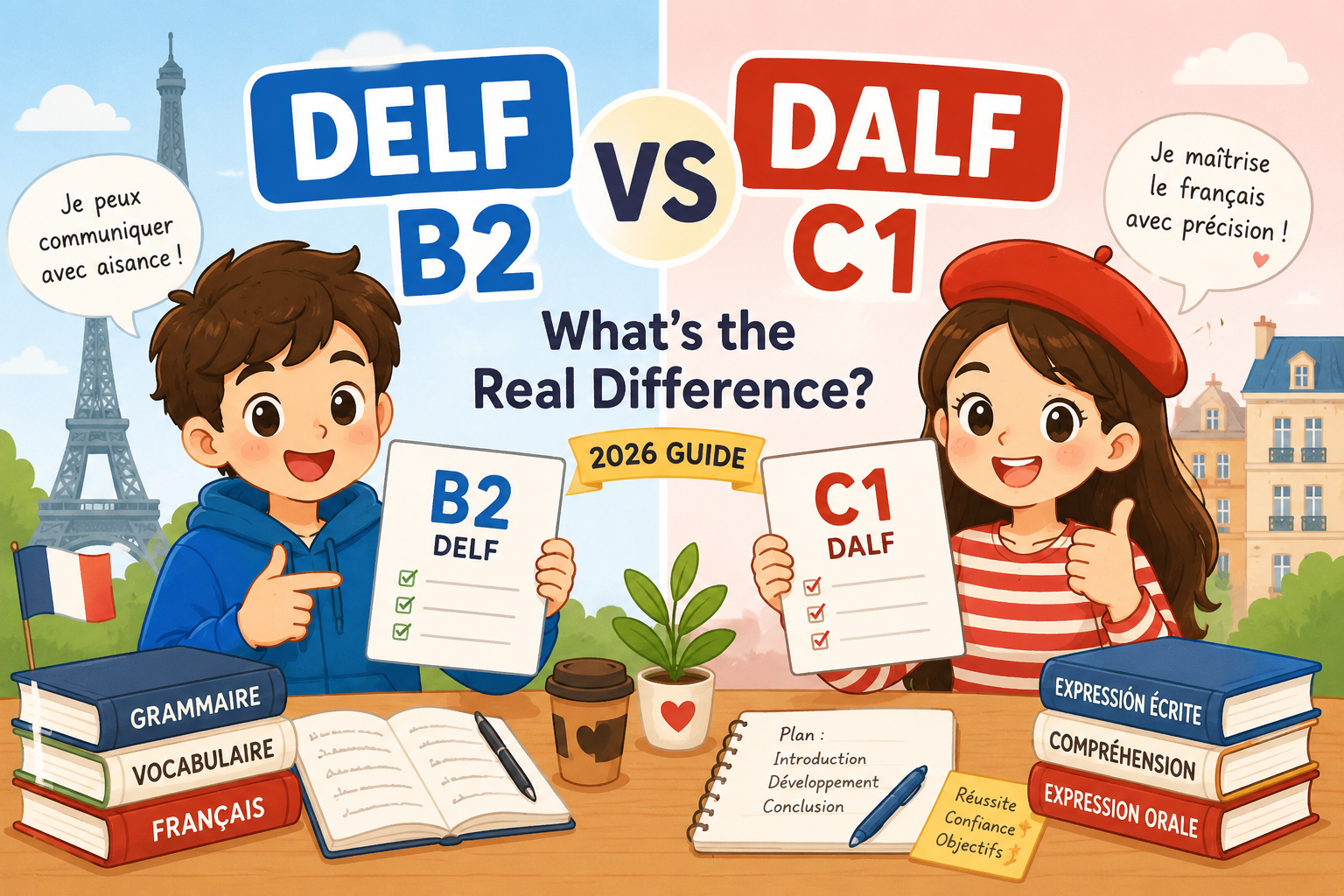
DALF C1 vs. DELF B2: What’s the Real Difference?
Original illustration — DELF B2 vs. DALF C1
If you’ve been studying French for a while, you’ve probably run into two intimidating acronyms: DELF B2 and DALF C1. Both are official diplomas issued by the French Ministry of Education, both are valid for life, and both are accepted by universities, employers, and immigration authorities around the world. But they are not the same exam, they are not the same difficulty, and choosing the wrong one can cost you time and money.
In this guide, we break down exactly what separates DALF C1 from DELF B2 — level, format, scoring, and who each diploma is really for — so you can register for the exam that actually matches your goals.
What Are DELF and DALF, Exactly?
DELF (Diplôme d’études en langue française) and DALF (Diplôme approfondi de langue française) are two parts of the same official certification system. Together they cover all six levels of the Common European Framework of Reference for Languages (CEFR), from absolute beginner to near-native mastery.
- DELF covers levels A1, A2, B1, and B2 — beginner to upper-intermediate.
- DALF covers levels C1 and C2 — advanced to mastery.
Who Issues These Diplomas?
Both DELF and DALF are issued by the French Ministry of National Education and administered worldwide by France Éducation international, the official body responsible for French-language certification. This is what makes them different from tests like the TCF or TEF: DELF and DALF are diplomas, not time-limited certificates.
Are DELF and DALF Diplomas Permanent?
Yes. Once you pass, the diploma is yours for life — there’s no renewal, no retest, and no expiry date. This is a major advantage over tests like the TCF or TEF, which are typically only valid for two years.
DELF B2 vs. DALF C1: The Core Difference at a Glance
The simplest way to think about it: DELF B2 proves you can function comfortably in French — at university, at work, in daily life. DALF C1 proves you can perform at a near-professional, near-academic level, handling nuance, abstraction, and complex argumentation.
| Feature | DELF B2 | DALF C1 |
|---|---|---|
| CEFR Level | Upper-Intermediate | Advanced |
| Typical Use Case | University admission, general employment, naturalisation | Master’s/PhD admission, high-level jobs, exemption from university language tests |
| Exam Sections | 4 separate sections: listening, reading, writing, speaking | Reading + writing merged into one paper; listening and speaking remain separate |
| Total Score | Out of 100 (pass mark 50) | Out of 100 (pass mark 50) |
| Oral Prep Time | 30 minutes | 60 minutes |
| Prerequisite | None — independent diploma | None — independent diploma (you can take it without holding DELF B2) |
DELF B2 Explained
DELF B2 is often the first “serious” milestone French learners aim for. It confirms that you can communicate clearly and spontaneously in most situations, defend a point of view, and understand the main ideas of complex texts on concrete and abstract topics.
What DELF B2 Tests
The exam is split into four independent papers: listening comprehension, reading comprehension, written production (typically an argumentative essay or opinion piece), and an oral presentation followed by a debate with the examiner.
Who Should Take DELF B2
DELF B2 is generally the right choice if you’re applying to a French bachelor’s program, meeting a workplace language requirement, or working toward French naturalisation, which as of January 2026 requires B2-level French. It’s also a strong, achievable goal if you’ve been taking a structured online French speaking course and want a recognised diploma to show for it.
DALF C1 Explained
DALF C1 sits at the advanced end of the CEFR scale. It certifies that you can understand long, demanding texts, pick up on implicit meaning, and express yourself fluently and precisely without obviously searching for words — the level expected in academic and professional French environments.
What DALF C1 Tests
Since a 2020 reform, DALF C1 no longer has specialised subject tracks — every candidate sits the same general exam, drawing on themes like the environment, technology, education, work, and culture. Reading comprehension and written production are combined into a single 2.5-hour paper (summarising a dossier of documents, then writing an argued essay), while listening comprehension and the oral exam remain separate.
Who Should Take DALF C1
DALF C1 makes sense if you’re applying to a Master’s or PhD program in France, targeting a role that requires fluent professional French, or want a permanent exemption from university French-language entry tests. Holding DALF C1 also automatically satisfies the B2 naturalisation requirement, since it certifies a higher level.
DELF B2 vs. DALF C1: Exam Format Compared
Listening, Reading, Writing, Speaking Breakdown
Both exams test the same four skills, but the architecture changes at the advanced level. At B2, each skill is assessed in its own dedicated paper. At C1, reading and writing merge into a single synthesis-and-essay task, which demands stronger time management and the ability to juggle multiple source documents at once.
Scoring and Pass Marks
Both exams are scored out of 100, with 50 needed to pass. However, because DALF C1 tasks are longer, more abstract, and more document-heavy, reaching that same 50-point threshold typically requires meaningfully stronger command of the language than at B2.
Do You Need to Pass DELF B2 Before Taking DALF C1?
No. DELF and DALF are independent diplomas — not a ladder you’re required to climb rung by rung. You can register directly for DALF C1 without ever having sat DELF B2, provided your actual level supports it. That said, attempting an exam well above your current level wastes both the registration fee and your time, so an honest self-assessment (or a placement test with a tutor) is worth doing first.
Which One Should You Choose?
Choose DELF B2 If…
- You’re applying to a French bachelor’s degree or CEGEP program
- You need to meet a general workplace French requirement
- You’re pursuing French naturalisation and need the B2 threshold
- You want a strong, realistic milestone after intermediate-level study
Choose DALF C1 If…
- You’re applying to a Master’s or PhD program taught in French
- Your target job explicitly requires advanced or “fluent” French
- You want a lifetime exemption from university French entry tests
- You already communicate comfortably and want formal recognition of an advanced level
Original illustration — preparing a written essay
How to Prepare for DELF B2 or DALF C1
Whichever diploma you’re aiming for, preparation should focus on exam technique as much as general French ability — knowing how to structure a synthesis, manage your time in a 2.5-hour paper, or handle an examiner’s follow-up questions matters just as much as vocabulary. A guided course also helps you avoid plateauing, since speaking practice with real feedback is hard to replicate alone.
If you’d like structured, exam-focused support, take a look at our online French speaking course resources, where we cover practice materials and speaking practice tailored to both DELF and DALF candidates.
Frequently Asked Questions
Is DALF C1 much harder than DELF B2?
Yes. C1 requires understanding implicit meaning, handling long and abstract texts, and expressing complex arguments fluently — a significant step up from B2’s upper-intermediate demands.
Can I skip DELF B2 and go straight to DALF C1?
Yes, since the diplomas are independent. It’s only advisable if your actual French level realistically matches C1 expectations.
Which diploma satisfies French naturalisation requirements?
DELF B2 meets the current requirement directly. DALF C1 also satisfies it, since it certifies a level above B2.
Do DELF and DALF diplomas expire?
No. Unlike the TCF or TEF, DELF and DALF diplomas are valid for life once earned.
Which diploma do universities prefer?
Most undergraduate programs accept DELF B2. Master’s and PhD programs more often require or strongly prefer DALF C1.
Final Thoughts
There’s no universally “better” diploma between DALF C1 and DELF B2 — only the one that matches where you’re headed. If your goal is university admission, workplace communication, or naturalisation, DELF B2 is usually the practical, achievable target. If you’re aiming for graduate study or a professional role that demands advanced fluency, DALF C1 is worth the extra preparation. Either way, both diplomas are permanent, internationally respected proof of your French — a real return on the time you put into learning it.
Original illustration — DELF / DALF diploma, valid for life