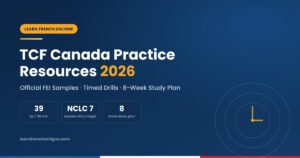
TCF Canada Practice Resources 2026: Official Samples, Drills & an 8-Week Study Plan
Everything LFE students need to prepare for TCF Canada the right way: the real official sample inventory, a per-skill drilling method, NCLC score bands, and a timed 8-week roadmap to NCLC 7.

Structured, timed practice — not random PDFs — is what actually moves your TCF Canada score.
If your Express Entry plan depends on French, the quality of your TCF Canada practice matters more than the quantity. Candidates who collect dozens of random YouTube clips and PDF dumps, then rehearse without a timer or a target NCLC level, tend to stall for months. The listening section alone gives you just 39 questions in 35 minutes — decision speed, not vocabulary, is what separates a pass from a retake.
This guide walks through the confirmed 2026 TCF Canada format, points you to the genuine official practice inventory published by France Éducation International (FEI), and lays out the timed 8-week plan our TEF-TCF Canada Prep Course instructors use with students aiming for NCLC 7. You can browse current batch dates any time on the LFE Courses & Live Classes page.
Key takeaways
- FEI’s official sample set covers 7 listening examples, 4 reading examples, and 3 language-structure examples, plus downloadable speaking and writing PDFs.
- TCF Canada has 4 sections totalling 2 hours 47 minutes; listening alone packs 39 questions into 35 minutes.
- Comprehension sections score 100–699; Writing and Speaking are scored 0–20, then mapped to NCLC.
- Results typically arrive in about 15 working days; you must wait a minimum of 30 days before retaking.
- NCLC 7 across all four skills is the threshold most French-stream Express Entry candidates need.
On this page
What is the official TCF Canada format in 2026?
TCF Canada runs four sections across 2 hours and 47 minutes, and each is scored on a different scale — which is exactly why a one-size-fits-all study plan fails. Listening and Reading use a 100–699 comprehension scale; Writing and Speaking are graded 0–20 by an examiner. Learn the structure before you touch a single practice file, because the format dictates the drill.
| Section | Time | Tasks / questions | Score scale |
|---|---|---|---|
| Listening comprehension | 35 minutes | 39 multiple-choice questions | 100–699 |
| Reading comprehension | 60 minutes | 39 multiple-choice questions | 100–699 |
| Written expression | 60 minutes | 3 tasks (60–120, 120–150, 120–180 words) | 0–20 |
| Oral expression | ~12 minutes (2 min prep) | Live one-on-one interview | 0–20 |
Format confirmed on the official France Éducation International TCF Canada page, 2026.
For Express Entry, IRCC converts these raw scores into NCLC levels, and most French-stream draws require NCLC 7 across all four skills. Roughly, that means 458–502 in listening, 453–498 in reading, and 10–11 in both writing and speaking. Use our TCF Canada Score Calculator guide to translate any practice score into its NCLC band before you set a study target.
Where to find official TCF Canada practice samples
Start with the genuine source: the France Éducation International sample page publishes 7 listening examples, 4 reading examples, 3 language-structure examples, and downloadable speaking and writing PDFs labelled for TCF Canada. Treat any site claiming a specific count of “full official TCF Canada practice tests” as a red flag — FEI does not publish complete numbered mock exams, only representative item sets per skill.
| Official FEI resource | What it covers | How to use it |
|---|---|---|
| 7 listening examples | Audio item styles across difficulty | Build your first timing baseline |
| 4 reading examples | Passage and question formats | Calibrate scanning speed |
| 3 language-structure examples | Grammar and lexis item types | Spot recurring grammar traps |
| Speaking PDF samples | Prompts and response shape | Model answer length for 12 minutes |
| Writing PDF samples | All 3 written tasks, word ranges | Practise to exact word counts |
Source: France Éducation International, official TCF sample page, 2026.
Only the test maker guarantees the exact register, timing, and rubric — so exhaust the official samples first, then use vetted unofficial banks purely for extra volume, never for calibration.
How to drill each TCF Canada section
Each section rewards a different kind of practice, and treating them all the same is the most common reason scores stall.
Listening comprehension
Train under a hard 35-minute clock from your very first session — that’s roughly 54 seconds per question, so passive listening won’t help. Play each official sample once only, force a decision before moving on, and log every miss by type: detail, inference, or speaker intent.

Reading comprehension
Practise in timed 60-minute blocks for the full 39 questions rather than untimed passive reading. Scan for the answer location first, then read closely, and rehearse skipping a hard passage and returning to it later so it never sinks the section.
Written expression
Write all three tasks to their exact word ranges: 60–120, 120–150, and 120–180 words. Build reusable openings and connectors so exam minutes go to content instead of blank-page panic, and self-check gender agreement and conjugation every time — production grading penalises those errors heavily.

Oral expression
The interview runs about 12 minutes with roughly 2 minutes of preparation, so rehearse from a short outline rather than a memorised script. Record yourself and grade structure and fluency against the official speaking PDF.
For guided, examiner-style feedback on all four skills, our TEF-TCF Canada Prep Course pairs every drill with a target NCLC band instead of unstructured activity, with progress tracked inside your own LFE learner dashboard.
A timed 8-week TCF Canada study plan
Results take about 15 working days, and a missed target means a 30-day wait before you can resit — so a structured plan beats scattered study every time. This 8-week plan assumes a B1–B2 starting level aiming for NCLC 7, at roughly 8–10 focused hours a week.
| Week | Primary focus | Timed task |
|---|---|---|
| 1 | Diagnose all 4 skills with official samples | One sample per skill under exam timing; log baseline bands |
| 2–3 | Listening speed + reading scanning | 3 timed listening sets and 2 timed reading sets weekly |
| 4–5 | Written expression, all 3 tasks | 2 full writing sessions weekly to exact word counts |
| 6 | Oral expression from short outlines | 4 recorded speaking rehearsals, self-graded vs. PDF |
| 7 | Full timed mock across all 4 sections | One end-to-end simulation in a single sitting |
| 8 | Fix the weakest skill, then taper | Targeted drills only; light review 2 days before |
The plan is deliberately front-loaded on listening because 54 seconds per question is the constraint people underestimate most. If your week 1 diagnostic shows one skill far behind, shift a week from your strongest skill to the weakest — the structure flexes, the timed discipline does not.
Official vs. unofficial materials: how to choose
Think of it as two separate jobs. Official FEI samples answer “what does the real exam expect?” — timing, question style, audio register, and writing word counts must come from that page. Unofficial material answers “have I done enough repetitions?” — fine for volume once you know the real format, but discard anything that contradicts the official structure above.
- Calibrate with official only: timing, style, and rubric come from the FEI sample page.
- Add volume with vetted unofficial sets once your baseline is set.
- Reject false “official” claims — a fixed count of complete official tests is not something FEI publishes.
- Score against NCLC, not raw numbers — check the full 2026 conversion table in our TCF Canada Score Calculator guide.
- Add exam-day templates once your baseline is set — our TEF/TCF Exam Prep eBook has ready-to-use connectors and response structures for the written and oral sections.
How LFE prepares you for TCF Canada success
Converting scores is the easy part — reaching NCLC 7 across all four skills is where most candidates need structured support. At Learn French Enligne (LFE), our Canada-focused programs are built around the NCLC 7 threshold itself, not general fluency, so every class hour goes toward the skills that actually move your CRS score. See the full catalogue on our French Classes Online hub, from foundational A1 groups to exam-specific intensives.
Turn this guide into a real score gain
Browse live TEF-TCF batch dates, or sign in to your LFE dashboard if you’re already enrolled — either way, we’ll help you map a realistic path to NCLC 7.
If you’re weighing exam options first, our comparison of TCF Québec vs. TCF Canada and our guide to French course options for Canada PR are good next reads before you lock in a test date. New to LFE? Head to our homepage to see current cohorts, trainer profiles, and student results.
Frequently asked questions
How many official TCF Canada practice tests does FEI provide?
France Éducation International does not publish a fixed number of complete end-to-end mock tests. It provides official examples per skill — 7 listening, 4 reading, and 3 language-structure examples — plus downloadable speaking and writing PDFs. Any site claiming a specific count of full official tests isn’t describing the FEI sample page.
How long is the TCF Canada listening section?
Listening comprehension lasts 35 minutes and contains 39 multiple-choice questions — roughly 54 seconds per question. That pace makes decision speed the binding constraint, so run every listening drill under a hard 35-minute clock from your first session.
How is TCF Canada scored for Canadian immigration?
Listening and reading use a 100–699 scale; written and oral expression are scored 0–20. IRCC maps these to NCLC levels. NCLC 7 — common for French draws — is roughly 458–502 listening, 453–498 reading, and 10–11 in both writing and speaking.
When will I get my TCF Canada results, and how soon can I retake it?
Results are typically issued in about 15 working days after FEI receives the session papers, though some centres quote longer. The minimum gap between two sittings is 30 days, with no cap on total attempts. The certificate stays valid for 2 years.
Should I use official or unofficial TCF Canada practice materials?
Use official FEI samples to calibrate timing, question style, and rubric, then use vetted unofficial banks only for extra repetitions once you understand the real format. Discard any unofficial material that contradicts the confirmed official structure.
Related reading on LFE
Sources & further reading
- France Éducation International – Official TCF sample page
- France Éducation International – TCF Canada test information
- IRCC – Express Entry language test requirements
- IRCC – Comprehensive Ranking System (CRS) criteria
Conversion tables and format details are set by FEI and IRCC and reviewed periodically. Always confirm current figures on the official pages above before booking your exam or submitting an Express Entry profile.